
Enterprise behavioral-health AI is moving beyond simple chatbots toward clinically governed platforms that combine AI with licensed clinicians, EHR/workflow integration, care navigation, documentation, measurement, and safety monitoring. In 2026, the strongest options are generally those where AI augments rather than replaces clinical judgment.
1. Lyra Health — Enterprise AI Mental Health Platform
Lyra Health is one of the strongest enterprise-oriented
Examples in 2026.
Its Lyra Empower platform combines employer mental-health benefits, provider matching, clinical care, coaching, digital resources, and AI. Lyra says its AI supports members, providers, and employers rather than functioning as an autonomous therapist.
Key AI capabilities
- AI-assisted care navigation and provider matching
- Conversational AI support between sessions
- Personalized member experiences
- Provider-facing AI insights
- AI-supported clinical workflows
- Care coordination and benefits integration
- Human-in-the-loop clinical oversight
Lyra introduced its Care Insights Hub, an AI-powered capability within its provider EHR that analyzes client interactions and provides clinically grounded insights intended to help providers reflect on and improve their practice.
Lyra also explicitly describes its model as human-in-the-loop:
clinicians remain responsible for treatment decisions while AI assists with access, risk identification, and support.
Best suited for: large employers, global organizations, health-benefit programs, and enterprises wanting integrated behavioral-health access plus AI.
2. Sonder Mind — AI Companion + Clinically Grounded AI
Sonder Mind is another important 2026 platform.
Its Sonder AI mental-health companion is designed to support people between therapy sessions by helping them reflect on emotional states, track well-being, and process experiences. Sonder Mind has publicly discussed its safety-testing infrastructure rather than treating the AI as an unrestricted general-purpose chatbot. Sonder Mind is also researching specialized language models trained around real therapy dynamics. Its 2026 work evaluates models across clinical quality, safety, bias/fairness, and privacy.
Enterprise strengths
- AI companion integrated into behavioral healthcare
- Therapy-oriented conversational AI
- Safety evaluation
- Privacy considerations
- Clinically grounded model development
- Human-care integration
- Potential for longitudinal behavioral support
Best suited for: organizations interested in AI-assisted therapy experiences and between-session support.
3. Talk space — AI-Augmented Digital Behavioral Healthcare

Talk space is another major behavioral-health platform incorporating AI into its care model. In 2026, Talk space introduced Tee, an AI mental-health support tool intended to supplement not replace licensed therapy. It is designed around clinician oversight, privacy protections, and safety guardrails.
Potential enterprise applications
- Employee mental-health support
- Always-available conversational assistance
- Therapy between-session support
- Clinician insights
- Early identification of behavioral patterns
- Digital engagement
The important distinction is that Tee is positioned as supportive technology, not an autonomous diagnostic or treatment system.
Best suited for: employers and organizations already using digital behavioral-health services and wanting AI-supported access.
4.What Makes an Enterprise Behavioral Health AI Platform Reliable?
A platform should not be judged simply by whether it has a chatbot. Enterprise buyers should examine several layers.
1. Clinical governance
Look for:
- Licensed-clinician involvement
- Clinical review of AI outputs
- Defined escalation procedures
- Human override
- Evidence-based interventions
- Continuous safety monitoring
Lyra, for example, says clinical expertise is embedded throughout AI development, testing, monitoring, and delivery.
2. Safety and crisis escalation
Behavioral health is a high-risk AI application. A serious enterprise platform should have mechanisms for recognizing potentially dangerous situations and escalating appropriately. The 2026 Sonder Mind safety work illustrates why purpose-built safety testing is important for mental-health AI.
3. Privacy and security
Enterprise deployments should evaluate:
- HIPAA compliance where applicable
- Encryption
- Access controls
- Audit logging
- Data-retention policies
- Vendor data-use policies
- AI-training data restrictions
- Integration security
- Consent and user controls
4. EHR and workflow integration
The best enterprise platforms increasingly place AI inside existing clinical workflows rather than forcing clinicians to use another disconnected application.
Lyra’s AI-enabled provider capabilities, for example, are integrated into its EHR environment.
5. Measurable outcomes
Enterprise buyers should demand evidence around:
- Engagement
- Treatment adherence
- Time to care
- Clinical outcomes
- Provider productivity
- Patient/member satisfaction
- Hospitalization or crisis indicators where appropriate
- Cost per member
- Return on investment
AI adoption by itself isn’t an outcome.
5.Enterprise Behavioral Health AI Use Cases in 2026
| Use case | How AI helps |
| Care navigation | Matches people with appropriate services/providers |
| Triage | Helps organize needs and determine appropriate next steps |
| Clinical documentation | Reduces administrative workload |
| Therapy support | Provides structured assistance between sessions |
| Care insights | Identifies patterns in clinical interactions |
6.Benefits for Large Enterprises
- Lower administrative burden
AI can automate or assist with documentation, intake, navigation, scheduling, and information retrieval.
- Faster access to care
AI-powered matching and navigation can reduce friction between identifying a need and finding an appropriate provider.
- 24/7 support
Conversational systems can provide basic support outside normal clinical hours, while escalation pathways connect users with human care when necessary.
- Better provider visibility
AI-generated insights can help clinicians identify patterns that might otherwise be difficult to see across large amounts of information.
- Scalability
An enterprise can potentially support a much larger population without requiring every interaction to involve a clinician.
Major Risks
Enterprise behavioral-health AI also has significant limitations.
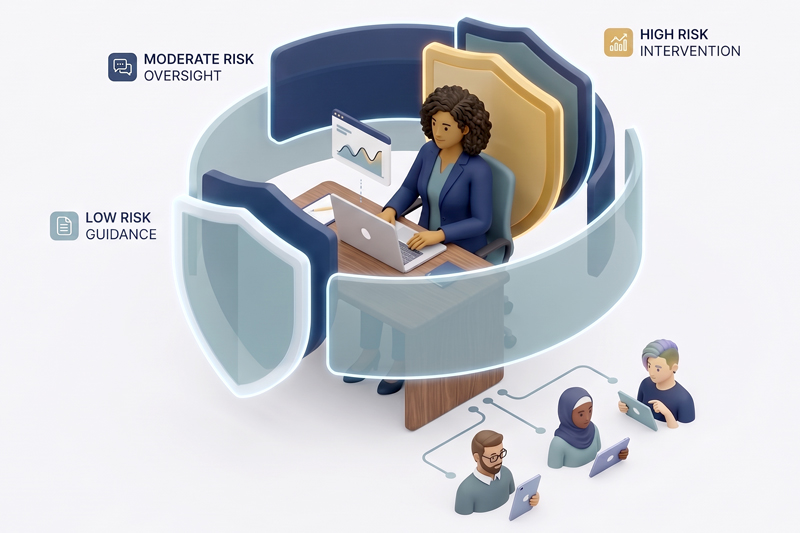
1.AI hallucinations: Incorrect mental-health guidance can cause harm.
2.Over-reliance: Users may incorrectly assume an AI companion is equivalent to a therapist.
3.Privacy: Behavioral-health conversations contain extremely sensitive information.
4.Bias: Models may behave differently across cultures, languages, demographics, or clinical populations.
5.Crisis handling: A chatbot must not be treated as a substitute for emergency or crisis services.
6.Clinical liability: Enterprises need clear accountability for AI-supported decisions.
7.Integration risk: An impressive AI model can still fail if it doesn’t fit the organization’s EHR and clinical workflow.
Recent healthcare-AI research similarly emphasizes the importance of workflow-aware evaluation, including continuity, evidence traceability, and escalation decisions—not merely whether an AI can answer medical questions.
2026 Enterprise Platform Comparison
| Platform | Main AI direction |
| Lyra Health | AI navigation, care matching, provider insights, conversational support |
| Sonder Mind | AI companion, therapy-oriented models, safety research |
| Talk space | AI companion + clinician-supported digital care |
| Traditional EHR/behavioral-health AI | Documentation, workflow, analytics |
| General-purpose AI chat bots | General conversation |
Bottom Line
Enterprise behavioral health AI in 2026, reliability is less about having the most advanced chatbot and more about combining AI + clinical oversight + safety + privacy + workflow integration + measurable outcomes. Among current platforms, Lyra Health stands out for the breadth of its enterprise behavioral-health ecosystem and its clinically governed AI approach, while Sonder Mind and Talk space demonstrate important approaches to AI-supported behavioral-health engagement. For an enterprise buying decision, the strongest architecture is generally AI-assisted care—not AI replacing clinicians.