Introduction
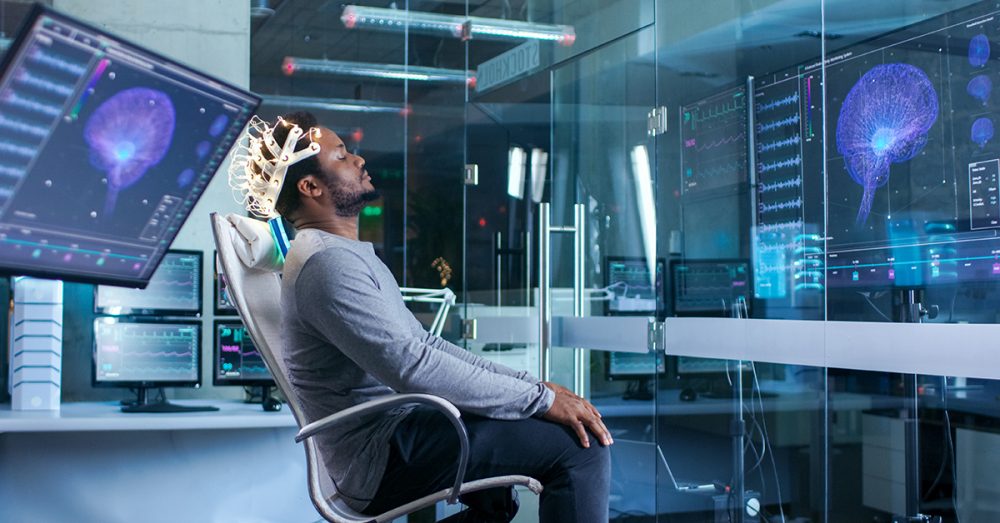
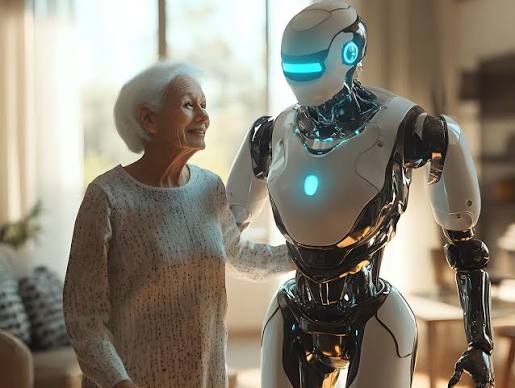
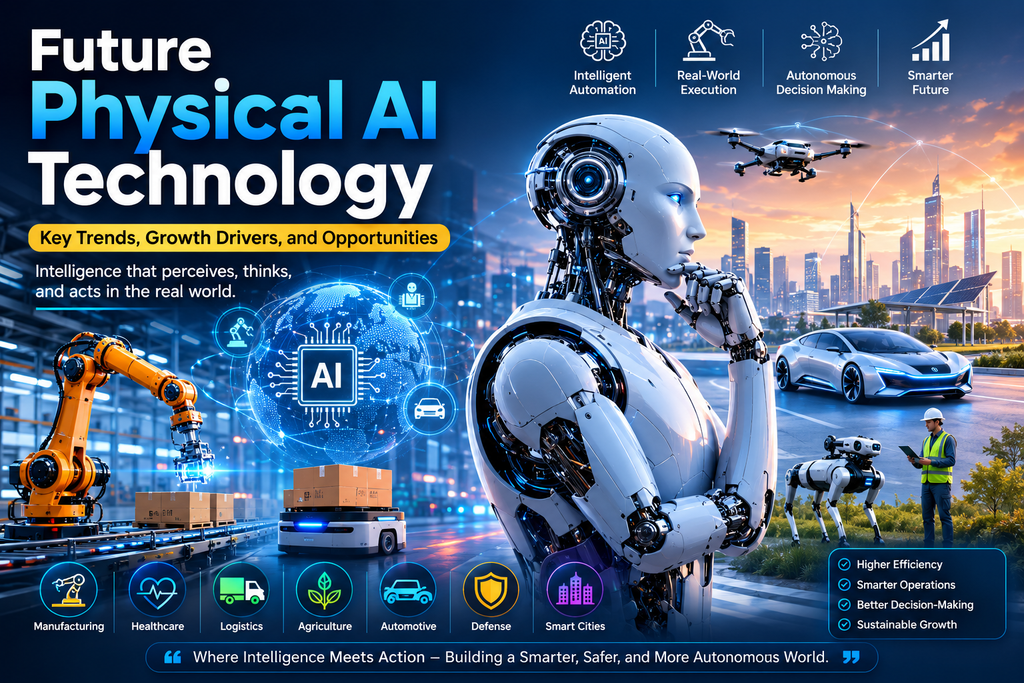
Physical AI is an emerging area of artificial intelligence focused on systems that can perceive, understand, learn, and act in the physical world. Unlike traditional AI that primarily works with text, images, audio, or digital data, Physical AI connects intelligence with machines such as robots, autonomous vehicles, drones, industrial equipment, and smart devices. In 2026, Physical AI is becoming an important technology for developing machines that can operate in dynamic environments and respond to real-world situations.
1# What Is Physical AI?
Physical AI refers to AI systems designed to interact with the physical environment.
A simple Physical AI system can follow this cycle:
Sense → Understand → Decide → Act → Learn
For example, an intelligent robot might use cameras and other sensors to identify an object, AI to determine what it is, a planning system to decide what to do, and robotic hardware to physically pick it up.
2# How Physical AI Works
1. Sensors Collect Information
Physical AI machines use sensors to understand their surroundings. Depending on the application, these can include:
- Cameras
- Depth sensors
- LiDAR
- Microphones
- Force and pressure sensors
- Temperature sensors
- Motion sensors
- Position sensors
These sensors provide information about the machine’s environment.
2. AI Perceives the Environment
AI models process sensor information to recognize objects, people, obstacles, locations, and changes in the environment. Computer vision can help a robot understand what its cameras are seeing, while other AI models can process sound, movement, and sensor data.
3. AI Makes Decisions
After interpreting its environment, the system determines what action should be taken.
For example,
Where should it move?
Which package should it pick up?
4. Machines Take Physical Action
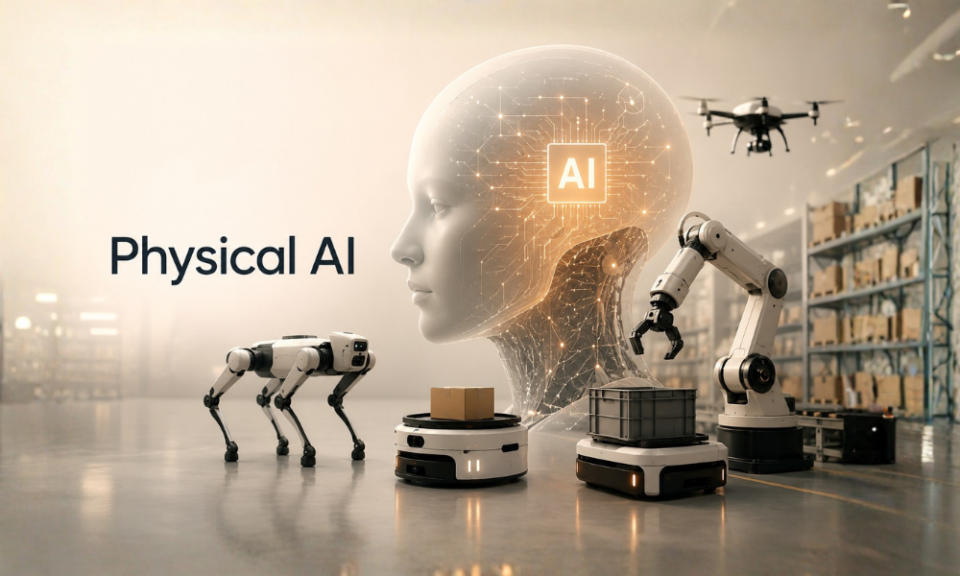
The AI’s decision is converted into physical movement through motors, robotic arms, wheels, actuators, or other hardware.
5. The System Learns
Advanced Physical AI systems can use machine learning and simulation to improve their performance. Feedback from previous actions can help systems become better at completing specific tasks.
3# Major Applications of Physical AI
Physical AI in Robotics
Robotics is one of the most important applications.
Intelligent robots can potentially perform tasks involving:
- Manufacturing
- Warehousing
- Inspection
- Logistics
- Agriculture
- Construction
- Healthcare
- Household assistance
AI gives robots greater ability to respond to changing environments rather than simply following fixed instructions.
Autonomous Vehicles
Physical AI can help autonomous vehicles perceive roads, identify objects, predict movement, and make driving decisions.
Applications include:
- Self-driving vehicles
- Autonomous delivery systems
- Robotaxis
- Industrial vehicles
- Autonomous trucks
Smart Manufacturing
Factories can use Physical AI to create more adaptive production systems. AI-powered machines can potentially inspect products, identify defects, manipulate components, and respond to production changes.
Warehouses and Logistics
Intelligent robots can assist with:
- Picking
- Sorting
- Packaging
- Inventory movement
- Transportation
- Warehouse inspection
This can help businesses improve efficiency while reducing repetitive manual work.
Agriculture
Physical AI can also support precision agriculture.
Robotic systems could help with:
- Crop monitoring
- Weed detection
- Harvesting
- Soil analysis
- Autonomous equipment
- Plant inspection
Healthcare
Robotics combined with AI can support healthcare applications such as rehabilitation, assistive robotics, hospital logistics, and certain surgical technologies. Human oversight and strict safety requirements remain essential in medical applications.
4# Physical AI vs. Generative AI
| Feature | Generative AI | Physical AI |
| Main environment | Digital | Physical |
| Typical output | Text, images, audio, code | Physical actions |
| Key technologies | AI models and computing | AI + sensors + robotics |
| Example | AI writing assistant | Autonomous robot |
| Interaction | Digital information | Real-world environment |
| Main challenge | Accuracy and reliability | Safety, perception, control |
The two technologies can also work together. A Physical AI robot could use generative or multimodal AI to understand natural-language instructions while using robotics systems to perform physical tasks.
5# Benefits of Physical AI
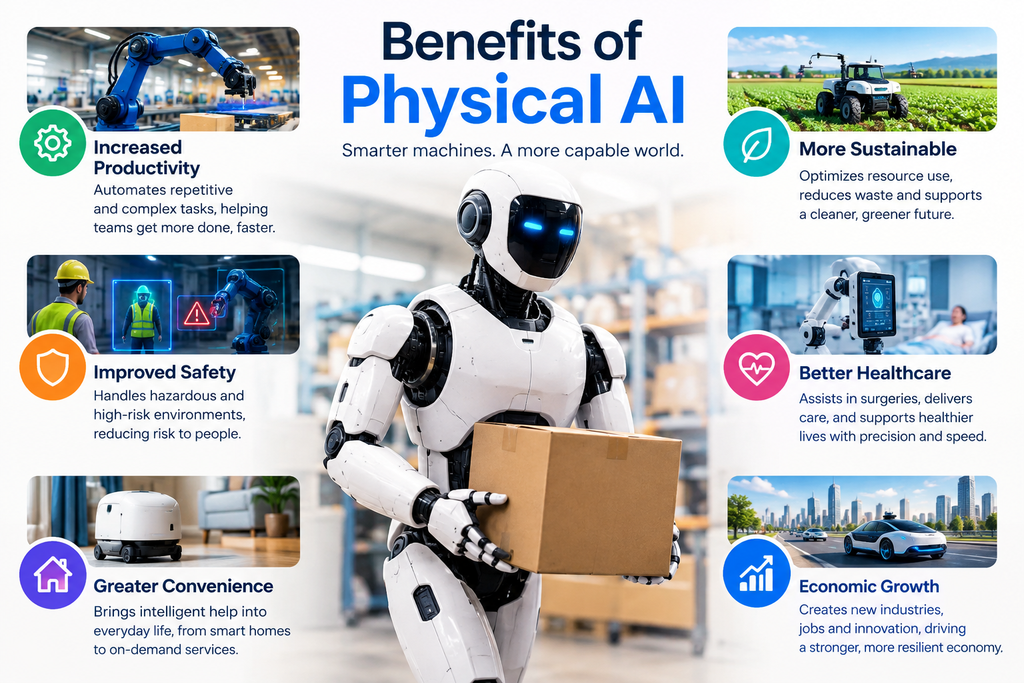
1. Greater Automation
Physical AI can automate tasks that require interaction with real-world environments.
2. Improved Efficiency
Intelligent machines can perform repetitive processes continuously and consistently.
3. Better Adaptability
Unlike rigid automation, AI-driven systems can potentially respond to changing conditions.
4. Increased Workplace Safety
Robots can perform certain dangerous or repetitive tasks, potentially reducing human exposure to hazardous environments.
5. Enhanced Productivity
Companies can combine human expertise with intelligent machines to improve workflows.
6. New Capabilities
Physical AI could make machines capable of tasks that were previously difficult to automate.
6# Challenges and Disadvantages
Safety
A machine operating in the real world can cause physical harm if its perception or decision-making fails. Safety mechanisms and human oversight are therefore critical.
High Development Costs
Physical AI requires hardware, sensors, computing infrastructure, software, testing, and maintenance.
Complex Environments
The physical world is unpredictable. Lighting, weather, unexpected objects, humans, and equipment can all affect performance.
Data Requirements
Training sophisticated AI systems can require large amounts of data, including simulated and real-world examples.
Cybersecurity
Connected machines can create new cybersecurity risks. Protecting robots, vehicles, factories, and their AI systems is increasingly important.
Workforce Impact
Greater automation could change job roles and increase demand for workers with robotics, engineering, AI, and technical skills.
7# Why Physical AI Matters in 2026
Physical AI is important because AI is moving beyond generating information toward taking action in the real world. The combination of increasingly capable AI models with advanced sensors, simulation, robotics, and computing could enable machines to perform increasingly complex tasks.
However, the technology is still developing. Real-world deployment requires extensive testing because physical environments introduce challenges that do not exist in purely digital AI applications.
8# The Future of Physical AI
The future could bring increasingly capable machines that can understand instructions, recognize their surroundings, plan actions, and cooperate with humans.
Potential developments include:
- More capable humanoid robots
- Smarter industrial robots
- Autonomous transportation
- AI-powered home robots
- Intelligent agricultural machines
- Advanced warehouse automation
- Collaborative robots
- AI-assisted construction equipment
The long-term goal is not simply to create machines that move, but machines that can understand their environment and perform useful tasks safely.
9# Physical AI and Humanoid Robots
Humanoid robots are receiving significant attention because their body structure is designed to operate in environments created for humans.
A capable humanoid robot could potentially:
- Understand a spoken instruction.
- Identify objects in its environment.
- Plan the required sequence of actions.
- Navigate around obstacles.
- Manipulate objects.
- Complete the requested task.
- Adjust its behavior based on feedback.
Achieving this reliably remains a major engineering challenge.
Physical AI in Business
Businesses can use Physical AI to improve operations in areas such as:
- Manufacturing
- Supply chains
- Logistics
- Retail
- Agriculture
- Construction
- Energy
- Transportation
The strongest business cases are likely to be tasks where automation can deliver measurable improvements in productivity, safety, consistency, or operating costs.
10# Key Technologies Behind Physical AI
Several technologies work together to make Physical AI possible:
- Machine learning for decision-making and pattern recognition
- Computer vision for environmental perception
- Robotics for physical movement
- Multimodal AI for processing different types of information
- Simulation for training and testing
- Edge computing for fast local processing
- Sensors for collecting environmental data
- Motion planning for controlling movement
- Reinforcement learning for learning through feedback
Conclusion
Physical AI represents the next major step in the evolution of artificial intelligence. Instead of limiting AI to computers and digital applications, Physical AI gives intelligent systems the ability to perceive and interact with the real world. In 2026, robotics, autonomous vehicles, manufacturing, logistics, agriculture, and other industries are important areas for Physical AI development. Although challenges involving safety, cost, reliability, cybersecurity, and workforce transformation remain, the technology has significant potential. The future of intelligent machines will likely depend on how effectively AI can combine reasoning, perception, learning, and physical action. Physical AI could ultimately transform machines from programmed tools into more adaptable partners capable of working alongside humans.