







Imagine a society in which providing behavioral healthcare is more about interacting with patients in meaningful ways than it is about organizing paperwork or working behind a desk. Software automation is expanding and improving the impact of effective care in the environment that behavioral health AI is creating. Eleos is setting the standard for this tech area as a leader in the industry. Our objective? Creating an operational environment that enables human clinicians to concentrate on what they do best—care for others—and making behavioral health therapy as effective as it is compassionate.
1. Behavioral health AI: What is it?
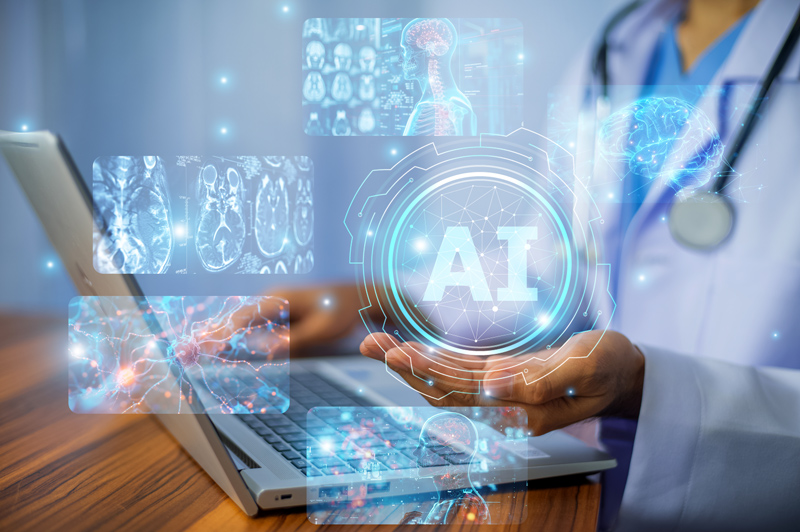
By combining agile software concepts with care operations, the Eleos behavioral health AI platform allows healthcare professionals to automate time-consuming administrative activities, freeing up more time and energy for patient care. It’s similar to having a smart assistant committed to improving the efficacy and efficiency of the patient journey as a whole.
2. What makes purpose-built AI crucial?
Given the complex interplay of biological, psychological, and socio-environmental elements as well as the requirement for individualized, long-term care delivery, treating behavioral health problems poses a number of special obstacles. For this reason, behavioral health AI is revolutionizing the field of behavioral health.
The following are all made achievable at scale by AI when applied to behavioral health, which has the potential to fundamentally alter the way that care is provided.
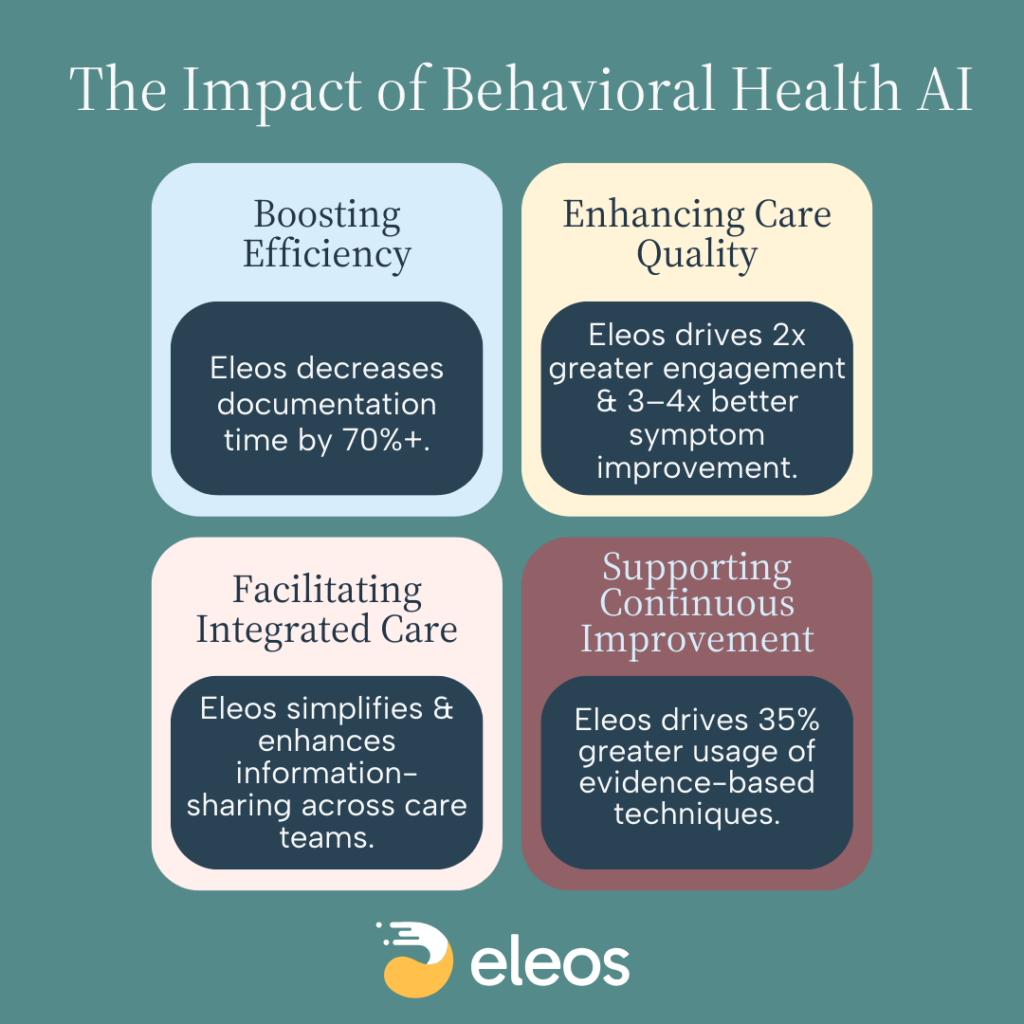
Efficiency: AI solutions help guarantee compliance and billing requirements are followed while reducing documentation time by at least 70%. This frees up more time for doctors to concentrate on providing the best care in the most
efficient way by reducing the amount of time spent creating (and sometimes revising) paperwork.
Care Quality: Better treatment plans result from more informed decision-making made possible by tools that offer session intelligence and care delivery insights. Additionally, they can enhance patient outcomes. In fact, studies reveal that when compared to standard treatment, patients whose therapists use Eleos have symptom relief that is three to four times greater. Additionally, Eleos-using therapists used 35% more evidence-based methods. All of this makes it possible for organizations and providers to increase the bar for care.
Integrated Care: Behavioral health-specific AI facilitates patient journeys, supports care delivery initiatives like the CCBHC model of care, and promotes collaboration and information exchange among various care teams. This is important because integrated care has a significant impact on patient outcomes in the field of behavioral health.
Continuous Improvement: AI platforms make it possible to continuously assess and improve care procedures on a large scale. Providers and supervisors can find areas for improvement and quickly make changes when data is consistently tracked and analyzed over time.
3. AI for behavioral health: Who can use it?
AI tools and solutions can be used by a variety of behavioral healthcare practitioners and organizations, such as:
Providers: By using behavioral health AI, psychologists, counselors, therapists, and case managers can lessen their administrative workload and enhance the standard of treatment they provide.
Institutions: Behavioral health AI can be used by hospitals, clinics, and mental health facilities to improve patient satisfaction, recruit and retain employees, and support regulatory compliance.
Digital and Virtual Health Providers: AI can be used by telemedicine and digital health platforms to offer users, wherever they may be, high-quality care.
Behavioral health AI can be used by managed care organizations and health insurers to enhance care coordination, guarantee adherence to care standards, and efficiently manage health outcomes.
4. The Core Trio of Eleos’ Behavioral Health AI Functions
Three key elements form the foundation of our specially designed AI platform:
Automation of Documentation
Leadership Reporting and Session Intelligence
Automation of Compliance
Together, these fundamental elements enable providers to improve client-provider interactions, revolutionize care delivery, and guarantee unwavering compliance in the ever-changing field of behavioral healthcare.
5. What distinguishes behavioral health AI-generated documentation from other kinds of AI-generated notes?
The “dot phrasing” technology employed by certain documentation assistance services differs significantly from the workflow automation present in an AI platform tailored to behavioral health. “Dot phrasing” is a digital shorthand method that automatically expands text into a phrase or sentence when a keyword or abbreviation is typed before a period.
However, it’s only shorthand. It’s a helpful tool that can save time, but it doesn’t have the ability to change or offer customized insights over time because it works according to pres-established criteria or templates. In essence, it is a reactive system that responds to a particular input by carrying out a predefined task.
6. What advantages does AI offer in terms of behavioral health?
Automated documentation has significant and revolutionary advantages for both businesses and mental health practitioners. An AI platform specifically designed for behavioral health:
Decreases Time Spent on Administrative Work: Eleos creates more than 80% of the progress note automatically, which greatly lessens the administrative load on doctors and enables them to cut down on documentation time by at least 70%.
Supports Compliance Requirements: Unbilled activities and overall compliance risk are decreased by the simplicity of documentation and the recommendations for compliant progress notes. Eleos users finish 90% of their notes within 24 hours of the session; other organizations estimate submission speeds as low as 4.4 hours. This safeguards the financial stability of healthcare organizations by preventing claim problems and denials.
Reduces Provider Stress: 90% of providers who use Eleos say they experience less stress at work, which eventually boosts employee morale, aids in recruitment and retention, and enhances the quality of care.
Enhances Accuracy: Eleos produces precise, session-specific, clinically comprehensive documentation by utilizing AI and sophisticated NLU models, which lowers the possibility of data entry mistakes or “copy-paste” notes. According to a recent study, Eleos Health’s machine learning models were very good at identifying evidence-based therapy methods.
7. AI’s Growing Significance in Behavioral Health
The manual, labor-intensive procedures of the past are gradually being replaced by new systems that use automation, intelligence, and data-driven insights to improve the efficacy and efficiency of care, thanks to behavioral health AI. Workflow automation for behavioral health is becoming an essential part of contemporary care operations thanks to platforms like Eleos.
Three crucial areas—documentation, session intelligence, and compliance—are where AI significantly benefits behavioral health enterprises. Organizations can enhance organizational efficiency, increase care quality, and maintain regulatory compliance by automating and improving various areas of care operations. The ultimate advantage? allowing medical professionals to concentrate more on their main goal of providing outstanding care rather than being mired in a mountain of paperwork