
The GenAI Divide describes the widening gap between companies that are experimenting with generative AI and those that are actually turning it into measurable business value. The original The GenAI Divide: State of AI in Business 2025 report found that, despite an estimated $30–40 billion in enterprise GenAI investment, about 95% of organizations studied reported zero measurable return, while roughly 5% were generating substantial value.
By 2026, the central issue has shifted from “Can businesses use AI?” to Can businesses scale AI and prove its financial impact? “Recent 2026 research similarly shows widespread adoption but a much smaller percentage of organizations achieving meaningful enterprise-level value.
1. What Is the GenAI Divide?
The GenAI divide is the separation between:
- AI adopters—organizations buying or experimenting with AI tools.
- AI scalers—organizations integrating AI into core workflows.
- AI leaders—organizations connecting AI directly to revenue, productivity, cost reduction, customer experience, or other measurable KPIs.
The key lesson is that AI adoption does not automatically equal AI transformation.
The original report found a steep funnel: around 60% of organizations evaluated enterprise AI systems, 20% reached the pilot stage, and only about 5% reached production with measurable value.
2. AI Is Everywhere, but Business Value Is Not
Generative AI has spread rapidly through organizations.
Employees now use tools for:
- Writing and editing
- Research
- Coding
- Customer support
- Marketing
- Data analysis
- Document processing
- Sales assistance
- Meeting summaries
- Knowledge management
- Software development
However, widespread individual usage can create the illusion of enterprise transformation.
A worker using an AI assistant to write an email may become more productive, but that does not necessarily translate into a measurable improvement in the company’s overall profit and loss statement.
This is one of the central differences between AI usage and AI value.
3. The 95% Problem
One of the most widely discussed findings associated with the GenAI Divide is the 95% figure.
The report argues that approximately:
- 95% of enterprise GenAI projects fail to produce measurable business value.
- 5% achieve significant value.
- Enterprise organizations invested approximately $30–40 billion in GenAI.
- More than 80% of organizations had explored or piloted tools such as ChatGPT or Copilot.
- Only a small percentage of enterprise-grade implementations reached production with significant measurable impact.
Importantly, the 95% statistic should not be interpreted as “95% of all AI technology fails.” It refers to the population and methodology examined by the report, particularly enterprise GenAI implementations and pilots.
That distinction matters when discussing AI investment in 2026.
4. Why So Many AI Projects Fail
The problem is often not the underlying AI model.
Common causes include:
Poor problem selection
Companies sometimes begin with:
Starting with technology rather than business outcomes can produce impressive demonstrations that have little financial impact.
Weak workflow integration
An AI system operating separately from the company’s CRM, ERP, databases, documents, or operational systems may struggle to deliver meaningful value.

Poor data
AI requires access to relevant, reliable, and appropriately governed data. Fragmented or low-quality information limits performance.
Lack of ownership
Projects can become stuck when nobody is responsible for turning a successful pilot into a production system.
No ROI measurement
If a company does not establish a baseline before implementation, it becomes difficult to determine whether AI actually improved performance.
Employee resistance
Employees may not understand how AI changes their responsibilities or may distrust AI-generated outputs.
Governance and security problems
Privacy, intellectual property, cybersecurity, regulatory requirements, and model risks can prevent promising experiments from reaching production.
These barriers are consistent with research emphasizing fragmented AI initiatives, weak integration, and the inability to move from pilots to scalable enterprise systems.
5. The Pilot Trap
One of the biggest problems in enterprise AI is the pilot trap.
A company may have:
- A successful demonstration.
- A small group of users.
- Positive employee feedback.
- A promising prototype.
- Several AI vendors.
But the project never becomes part of the company’s core operations.
This creates a cycle:
Experiment → Demo → Pilot → Evaluation → Another pilot
instead of:
Business problem → AI solution → Production → Measurement → Optimization → Scale
The companies crossing the GenAI divide are increasingly focused on the second model.
6. The Shift From Experimentation to Accountability
In 2026, executives are increasingly asking:
- How much revenue did AI generate?
- How much cost did it eliminate?
- How much employee time did it save?
- Did customer satisfaction improve?
- Did conversion rates increase?
- Did AI reduce errors?
- How quickly did the investment pay back?
- Can the system operate reliably at scale?
This represents a major change in AI strategy.
Previously, having an AI pilot could demonstrate innovation.
Now, measurable business outcomes are becoming the standard.
A 2026 Navigate AI synthesis reports that 74% of executives say AI has not met their financial ROI expectations, while 78% of organizations report regular AI use in at least one function.
7. CEO and Leadership Responsibility

AI is increasingly becoming a CEO-level business issue rather than simply an IT project.
Senior leaders need to determine:
- Which AI initiatives deserve funding?
- Which projects should be cancelled?
- Which workflows should be redesigned?
- Which employees require training?
- What risks are acceptable?
- How should AI performance be measured?
- Who owns the results?
The 2026 interpretation of the GenAI alignment, Divide places particular emphasis on CEO sponsorship, cross-functional alignment, and management adoption.
Successful organizations generally treat AI as an enterprise capability rather than something owned exclusively by the technology department.
8. AI Transformation Is Workforce Transformation
AI does not simply introduce another software tool.
It changes how employees perform their jobs.
For example:
Marketing
Traditional workflow:
Research → Write → Edit → Publish
AI-assisted workflow:
Research → AI-assisted drafting → Human review → Optimization → Publishing → Automated analysis
Customer service
Traditional:
Customer request → Agent research → Response
AI-enabled:
Customer request → AI retrieves information → Draft response → Human validation → Customer response
Software development
Traditional:
Developer writes → Tests → Debugs → Documents
AI-assisted:
Developer describes task → AI generates code → Developer reviews → Automated testing → Deployment
The goal is not necessarily to replace employees. Instead, AI can remove repetitive work and allow employees to focus on higher-value decisions.
9. The Importance of Managers
Managers play an important role in converting executive AI strategy into everyday behavior.
Leadership may approve an AI strategy, but employees need:
- Training
- Clear policies
- Appropriate tools
- Defined responsibilities
- Workflow redesign
- Performance expectations
- Support when AI produces poor results
Research cited in the 2026 GenAI Divide material emphasizes that managers who actively model AI use can accelerate organizational adoption.
10. AI Adoption vs. AI Integration
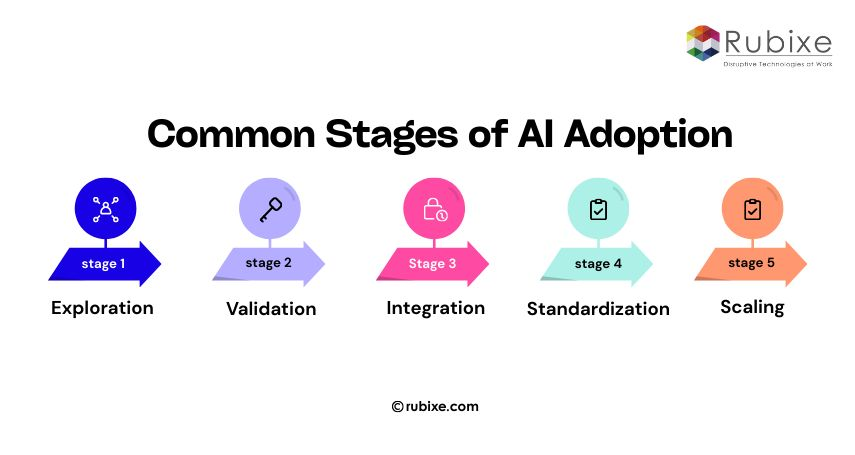
A crucial distinction is
AI adoption
Employees use ChatGPT, Copilot, or another AI tool.
AI integration
AI becomes part of a repeatable business process.
AI transformation
AI fundamentally changes how the organization operates and produces measurable business results.
A company might have thousands of employees using AI but still have very little enterprise AI transformation.
That is why adoption statistics alone can be misleading.
11. Where AI Creates the Most Value
AI tends to be particularly useful when applied to processes that are:
- Repetitive
- High-volume
- Data-heavy
- Time-consuming
- Rule-driven
- Document-intensive
- Expensive to perform manually
- Easy to measure
Examples include:
Customer service
AI can summarize conversations, recommend responses, and automate routine requests.
Sales
AI can qualify leads, summarize accounts, and assist sales representatives.
Marketing
AI can support content creation, personalization, research, and campaign analysis.
Finance
AI can help with document processing, forecasting, reconciliation, and financial analysis.
Human resources
AI can assist with recruiting workflows, employee questions, and administrative tasks.
Software engineering
AI coding assistants can support developers with code generation, testing, debugging, and documentation.
Operations
AI can identify bottlenecks, predict demand, and optimize processes.
12. Purpose-Built AI vs. General AI Tools
A significant 2026 theme is the movement toward purpose-built AI.
General-purpose tools can be powerful, but organizations often need systems designed around:
- Industry requirements
- Company data
- Existing workflows
- Compliance requirements
- Internal terminology
- Business processes
A 2026 Aptean study reported that while AI adoption was effectively universal among its surveyed organizations, only 46% had AI integrated into or essential to core work. It also found that 88% considered purpose-built AI very important or critical.
This suggests that the next phase of enterprise AI may focus less on simply acquiring powerful models and more on connecting AI to the right business environment.
13. AI Agents and the Next Phase

The evolution from chatbots to AI agents could further change the business landscape.
A chatbot primarily responds to a user.
An AI agent can potentially:
- Understand a goal.
- Access business information.
- Plan multiple steps.
- Use software tools.
- Execute tasks.
- Monitor results.
- Escalate problems to humans.
For example, instead of asking an AI:
“Write a sales follow-up email.”
An agent might:
Identify lead → Check CRM → Review previous interaction → Draft email → Personalize message → Send after approval → Update CRM.
This is potentially much more valuable because AI becomes part of the workflow rather than simply an assistant.
14. The Data Challenge
AI performance depends heavily on the information surrounding the model.
Companies need:
- Clean data
- Secure data
- Accessible data
- Consistent data
- Appropriate permissions
- Strong data governance
If customer information is scattered across multiple systems, an AI application may not have the context needed to make reliable decisions.
This is why enterprise AI increasingly requires integration with:
- CRM platforms
- ERP systems
- HR systems
- Data warehouses
- Knowledge bases
- Document repositories
- Internal applications
15. AI Governance
As AI becomes more deeply embedded in business operations, governance becomes increasingly important.
Organizations should establish policies covering:
- Data privacy
- Security
- Intellectual property
- Human oversight
- Model evaluation
- Bias
- Accuracy
- Auditability
- Regulatory compliance
- Vendor management
Governance should not simply prevent AI use.
Effective governance should help businesses use AI safely while maintaining enough flexibility to innovate.
16. Measuring AI ROI
A strong AI business case should establish a baseline.
For example:
Before AI
- 10 employees
- 1,000 requests/month
- 20 minutes/request
- $X operating cost
After AI
- 10 employees
- 1,000 requests/month
- 8 minutes/request
- Improved response time
- Reduced operating cost
The organization can then calculate:
AI ROI = (Financial Benefit − AI Cost) ÷ AI Cost × 100
Important measurements include:
- Revenue growth
- Cost savings
- Productivity
- Processing time
- Error rates
- Customer satisfaction
- Conversion rate
- Employee retention
- Customer retention
17. What Successful AI Companies Do Differently
Organizations that successfully cross the GenAI divide tend to:
Start with business problems.
They identify valuable problems before choosing technology.
Focus on fewer projects.
Rather than launching dozens of disconnected pilots, they concentrate resources on high-value use cases.
Integrate deeply.
AI becomes part of existing workflows.
Establish measurable KPIs.
Every project has a clear definition of success.
Give ownership to business leaders.
The project has someone accountable for the outcome.
Keep humans involved.
Employees review, supervise, or intervene where appropriate.
Iterate continuously.
AI systems are evaluated and improved rather than deployed once and forgotten.
The original GenAI Divide research identified a pattern among successful implementations involving deeper integration and stronger alignment with actual workflows.
18. The Cost of Doing Nothing
The GenAI divide creates a strategic risk in both directions.
Moving too slowly
Companies risk:
- Falling behind competitors
- Losing productivity
- Missing new revenue opportunities
- Becoming less attractive to employees
- Developing outdated workflows
Moving too quickly without strategy
Companies risk:
- Wasted investment
- Security problems
- Poor-quality AI outputs
- Employee confusion
- Duplicate systems
- Failed pilots
- Compliance problems
19. The 2026 AI Business Landscape
The evidence from 2026 points toward an important transition.
| Earlier AI approach | 2026 approach |
| Experiment with AI | Operationalize AI |
| Count pilots. | Measure outcomes. |
| Buy AI tools. | Build AI capabilities. |
| IT-led | Cross-functional |
| General-purpose tools | Purpose-built solutions |
| Employee experimentation | Workflow integration |
| Demonstrations | Production systems |
| AI adoption | AI ROI |
| Technology-first | Business-first |
This is the heart of the GenAI divide.
20. Key Numbers to Remember
Some of the most frequently cited figures are
- $30–40 billion: estimated enterprise GenAI investment referenced in the original GenAI Divide research.
- 95%: organizations/projects in the study reported as generating zero measurable return.
- 5%: the small group achieving substantial measurable value.
- 60%: organizations evaluating enterprise AI systems in the report’s funnel.
- 20%: reaching the pilot stage.
- 5%: reaching production in the cited enterprise-grade funnel.
- 78%: organizations reporting regular AI use in at least one function in Navigate AI’s 2026 synthesis.
- 46%: organizations in Aptean’s 2026 research reporting AI integrated into or essential to core work.
- 88%: respondents in Aptean’s research saying purpose-built AI is very important or critical.
These numbers come from different studies and methodologies, so they should not be treated as one unified global dataset.
21. The Future of AI in Business

The next stage of enterprise AI is likely to be defined by industrialization rather than experimentation.
Businesses will increasingly focus on:
- AI agents
- Automated workflows
- Enterprise AI platforms
- Industry-specific models
- AI governance
- AI security
- Human-AI collaboration
- AI-powered decision-making
- Process redesign
- Measurable ROI
The winners may not necessarily be companies with the largest number of AI pilots.
They will be companies that can turn AI into repeatable, reliable, and economically valuable business processes.
Conclusion
The GenAI divide is fundamentally a business execution problem, not simply a technology problem.
Generative AI has become widespread, but adoption alone does not guarantee transformation. The organizations gaining the greatest value are moving beyond experiments and integrating AI into important workflows, connecting it to proprietary data, assigning clear ownership, and measuring its impact against business KPIs.