







What Is AI Product Development?
AI product development is the process of designing, building, testing, and launching products that use artificial intelligence (AI) to solve business problems, improve customer experiences, and automate tasks. These products can include AI-powered mobile apps, chatbots, recommendation engines, predictive analytics platforms, intelligent CRM systems, and business automation tools.
Unlike traditional software development, AI product development uses technologies such as machine learning, natural language processing (NLP), computer vision, and generative AI to help software learn from data, understand user requests, recognize patterns, and generate useful outputs.
Businesses across healthcare, finance, education, retail, manufacturing, and technology are adopting AI product development to create smarter products, increase productivity, and remain competitive.
Why Is AI Product Development Important?
AI product development enables companies to build products that adapt to customer needs and improve through data-driven insights.
Key benefits include:
- Improved efficiency: Automate repetitive tasks and reduce manual work.
- Better customer experiences: Deliver personalized recommendations, support, and services.
- Faster decision-making: Analyze large datasets to identify patterns and trends.
- Business innovation: Develop new products and services that traditional software cannot easily provide.
- Scalability: Support more customers and larger workloads with automated systems.
- Competitive advantage: Introduce intelligent features that help businesses stand out.
- Cost optimization: Reduce operational costs by streamlining suitable workflows
Essential Technologies Used in AI Product Development
| Technology | Primary purpose | Example |
| Machine learning (ML) | Learn patterns from data. | Sales forecasting |
| Natural language processing (NLP) | Process human language | Customer support chatbot |
| Large language models (LLMs) | Generate and understand text | AI writing assistant |
| Computer vision | Analyze images and videos. | Defect detection |
| Retrieval-augmented generation (RAG) | Ground AI responses in retrieved information. | Internal company knowledge assistant |
| AI agents | Execute multi-step tasks using tools. | CRM workflow assistant |
| Cloud computing | Host and scale applications | Cloud-based AI platform |
| MLOps and LLMOps | Deploy, monitor, and maintain AI systems | Model performance monitoring |
The best technology depends on the use case, available data, performance requirements, security needs, and budget. Businesses should generally begin with the simplest reliable approach and introduce more complex AI systems only when they provide measurable value.
AI Product Development Services
Companies can work with an AI development agency or an in-house engineering team to build and maintain intelligent software.
Common services include:
- AI strategy and consulting: Identify opportunities, assess feasibility, and prepare a development roadmap.
- Custom AI software development: Build AI applications tailored to business requirements.
- AI model development: Train, adapt, evaluate, or integrate models for specific tasks.
- Generative AI integration: Add AI assistants, content generation, summarization, and intelligent search to existing products.
- AI agent development: Create systems that use tools and business data to complete defined tasks.
- AI application development: Build web and mobile applications with intelligent features.
- Data engineering: Create data pipelines and prepare information for AI systems.
- AI integration: Connect AI capabilities to CRM, ERP, customer support, and other business software.
- AI testing and governance: Evaluate accuracy, security, privacy, fairness, and reliability.
- AI maintenance and optimization: Monitor production performance, manage model changes, and control costs.
Common Challenges in AI Product Development
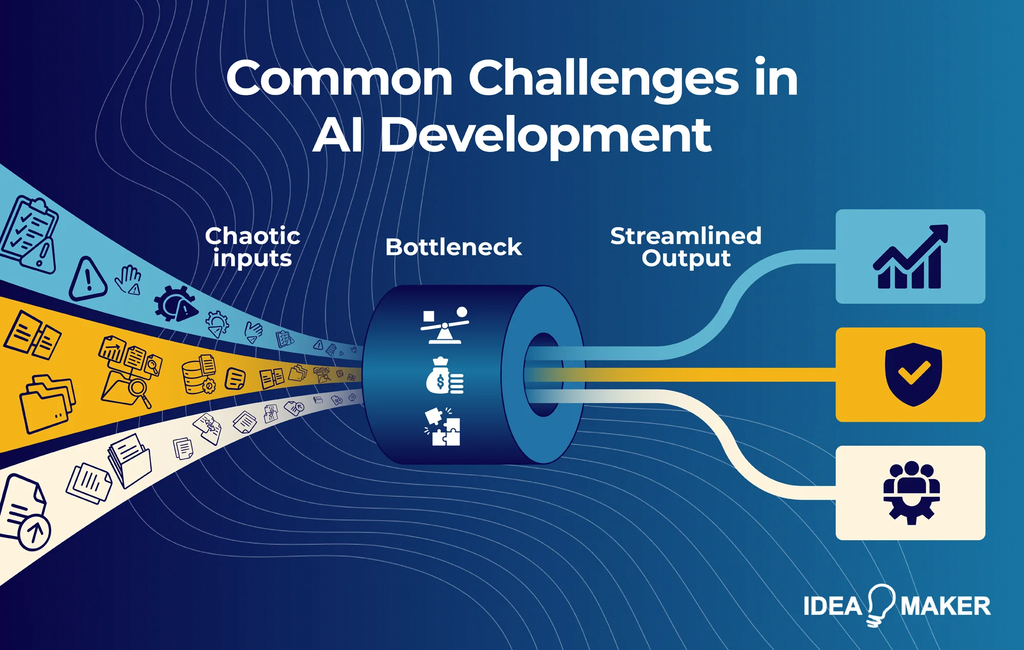
AI creates opportunities, but developing a dependable product requires careful planning.
- Poor data quality: Inaccurate, incomplete, or outdated data can undermine results.
- Unreliable AI outputs: Generative models can produce incorrect or fabricated information.
- Privacy and security risks: Sensitive information must be protected throughout the product lifecycle.
- Integration difficulties: AI components may need to work with legacy systems and multiple data sources.
- High operating costs: Model usage, infrastructure, and human review can become expensive at scale.
- Bias and fairness: Training data and model behavior can create unfair outcomes.
- Limited user trust: Customers may hesitate to rely on AI without transparency and clear controls.
- Ongoing maintenance: Models, data, software dependencies, and business requirements change over time.
Best Practices for Successful AI Product Development
- Start with a specific customer problem rather than adopting AI simply because it is popular.
- Define measurable success criteria before development begins.
- Validate demand with user interviews and an MVP.
- Use high-quality, legally obtained, and appropriately governed data.
- Select AI models based on real-world testing, not marketing claims alone.
- Design clear user experiences that communicate AI limitations.
- Build privacy, security, and responsible AI practices into the product from the beginning.
- Monitor accuracy, latency, customer satisfaction, and cost after launch.
- Collect user feedback and improve the product iteratively.
- Plan for scalability, maintenance, and model replacement when necessary.
Conclusion
AI product development helps businesses turn artificial intelligence into practical software solutions that improve efficiency, personalize customer experiences, and support smarter decisions. From AI chatbots and predictive analytics to generative AI applications and intelligent workflow automation, organizations can use AI to create products that address real customer needs.
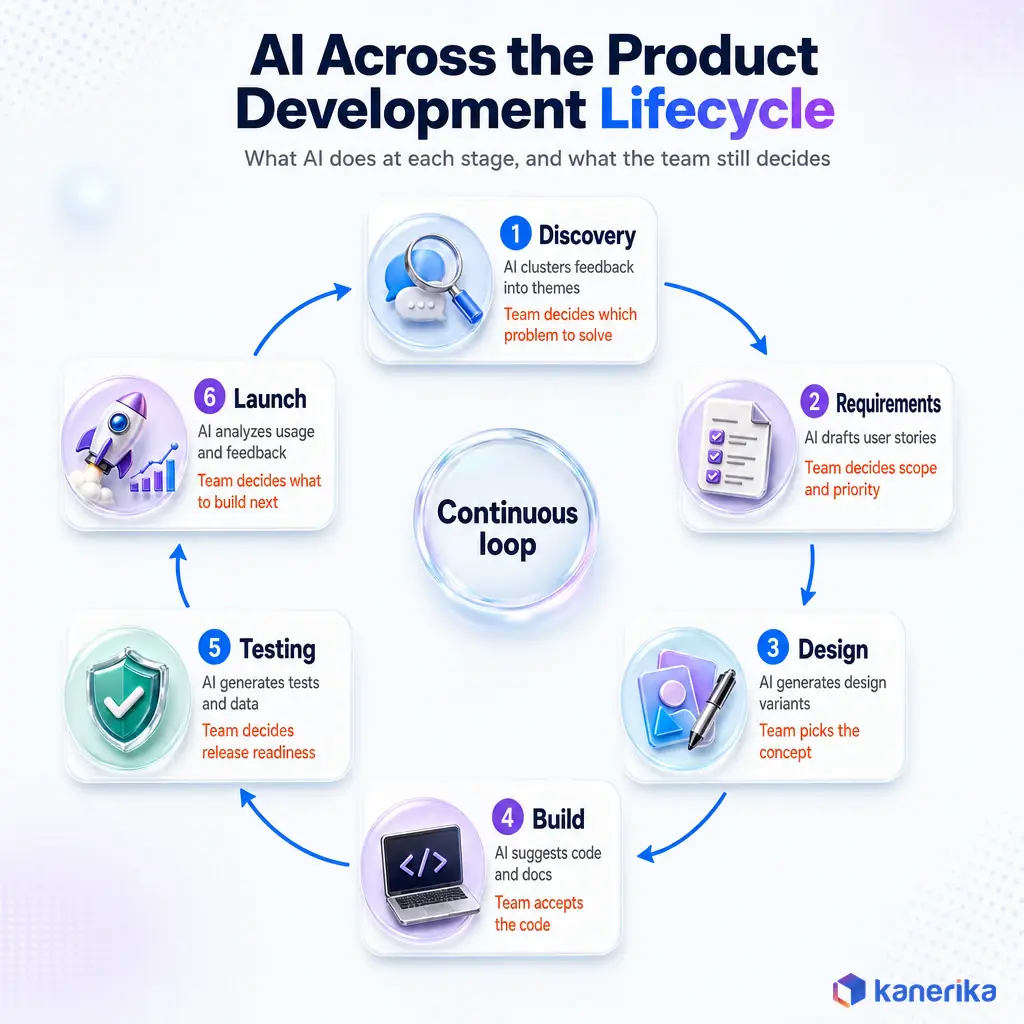
Successful development requires more than selecting a model. It involves market research, data preparation, thoughtful product design, rigorous testing, security, deployment, and continuous improvement. Businesses that begin with a clear problem, validate their ideas through an MVP, and measure results can reduce development risks and build more reliable AI products.