






AI guardrails are rules, controls, filters, and technical mechanisms designed to keep AI systems operating within defined safety, security, privacy, and business boundaries. As AI becomes more capable and is increasingly used in businesses, applications, customer service, coding, and automated workflows, guardrails can help reduce harmful, inaccurate, unauthorized, or inappropriate behavior.
1What Are AI Guardrails?
AI guardrail as a safety layer around an AI system. An AI model may generate an answer, make a recommendation, call a tool, or take an action. Guardrails can check the input, model output, or planned action before allowing it to proceed.
A simplified flow is:
User → Input Guardrail → AI Model → Output Guardrail → User
Extensive:
User → AI Agent → Guardrails → Tools/Data → Guardrails → Action
2.Why AI Guardrails Matter in 2026
They can interact with databases, software tools, APIs, documents, and business processes.
That creates additional risks, including:
- Incorrect information
- Unsafe recommendations
- Sensitive-data exposure
- Prompt injection
- Unauthorized actions
- Harmful or inappropriate content
- Data leakage
- Excessive permissions
- Unexpected automated behavior
Guardrails provide an additional layer of control to reduce these risks.
3.Main Types of AI Guardrails
1. Input Guardrails
Input guardrails examine what users provide to an AI system.
- Malicious instructions
- Sensitive information
- Abusive content
Example
an enterprise chatbot could prevent users from submitting confidential company information to an AI workflow.
2. Output Guardrails
Output guardrails evaluate the AI’s response before it reaches the user.
- Violates content policies
- Contains sensitive information
- Makes unsupported claims
- Uses prohibited language
- Exposes confidential data
- Fails a required format
3. Tool-Use Guardrails
AI agents increasingly interact with external tools.
Example:
AI Agent → Request database access → Permission check → Approved/Denied
This can help prevent an AI system from performing actions outside its authorized scope.
4. Data Guardrails
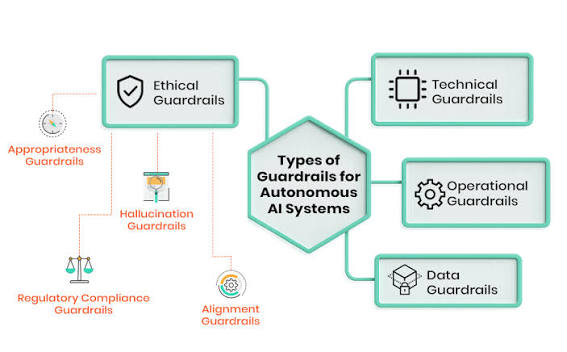
Data guardrails help control what information an AI system can access or process.
- Access controls
- Data classification
- Privacy rules
- Redaction
- Encryption
- Permission management
The objective is to ensure that an AI system receives only the information it actually needs.
5. Content Guardrails
Content guardrails help enforce rules around generated material.
Example
An organization might restrict an AI assistant from producing certain categories of content or from giving definitive answers in situations where human review is required.
4.AI Guardrails and Hallucinations
One important AI problem is hallucination
when a model produces information that sounds convincing but is inaccurate or unsupported.
Guardrails can reduce this risk through techniques
- Grounding responses in approved sources
- Retrieval-augmented generation (RAG)
- Citation requirements
- Confidence thresholds
- Fact-checking workflows
- Human review
However, guardrails cannot guarantee that an AI system will never hallucinate.
AI Guardrails for AI Agents
AI agents create a particularly important use case.
Unlike a simple chatbot, an agent may:
- Receive a request
- Plan a task
- Access information
- Use software tools
- Make decisions
- Perform an action
Guardrails can establish boundaries at each stage.
Example:
Request → Planning → Permission Check → Tool Call → Validation → Action
A financial workflow might require human approval before an AI agent can execute a high-value transaction.
5.Benefits of AI Guardrails
Improved Safety
Guardrails can prevent or reduce certain unsafe AI behaviors.
Better Privacy
Data controls can help limit exposure of sensitive information.
Greater Reliability
Validation mechanisms can catch some incorrect or unsupported outputs.
Regulatory Support
Organizations can use guardrails as part of broader AI governance and compliance programs.
Controlled Automation
Businesses can give AI systems useful capabilities while restricting high-risk actions.
Increased Trust
Clear controls can make employees and customers more comfortable using AI.
6.Limitations of AI Guardrails
Potential limitations include:
- False positives
- False negatives
- Overly restrictive rules
- New attack techniques
- Difficult-to-detect context
- Model changes
- Complex agent workflows
- Maintenance requirements
A guardrail itself can also be incorrectly designed or configured.
Therefore, organizations should combine guardrails with testing, monitoring, access controls, security practices, human oversight, and governance.
7.AI Guardrails vs. AI Governance
These concepts are related but different.
AI guardrails are practical controls that constrain or monitor AI behavior.
AI governance is the broader organizational framework covering policies, responsibilities, risk management, compliance, oversight, and lifecycle management.
A simple way to remember it:
Governance = the rules and management framework
Guardrails = technical and operational controls that help enforce those rules
3.How to Build an AI Guardrail Strategy?

Step 1: Identify AI Risks
Determine what could go wrong with the specific AI application.
Step 2: Define Allowed Behavior
Clearly establish what the AI can and cannot do.
Step 3: Control Access
Give AI systems only the permissions they need.
Step 4: Validate Inputs
Screen potentially dangerous, irrelevant, or sensitive inputs.
Step 5: Validate Outputs
Check generated responses before delivery or execution.
Step 6: Protect Tools and Data
Require authorization before AI systems access databases, APIs, files, or other systems.
Step 7: Add Human Approval
High-impact or irreversible actions should often require human review.
Step 8: Monitor Continuously
Track failures, unusual behavior, security incidents, and policy violations.
Example of AI Guardrails
Imagine an AI customer-service agent for an online store.
- Promise an unauthorized refund
- Reveal private customer information
- Give incorrect product information
- Modify an order without permission
With guardrails:
Customer request → AI analysis → Policy check → Permission check → Response/action → Monitoring
The agent could answer routine questions automatically while requiring human approval for sensitive account changes.
4.Best Practices for 2026
For organizations deploying AI systems, useful practices include:
- Use multiple layers of protection rather than one filter.
- Apply least-privilege access to AI agents.
- Separate informational responses from high-impact actions.
- Keep sensitive data protected.
- Log important AI actions.
- Test guardrails continuously.
- Provide clear escalation paths to humans.
- Monitor both model behavior and guardrail behavior.
- Update policies as AI applications evolve.
- Treat guardrails as part of a larger security and governance program.
Final Thought
AI Guardrails Safer AI in 2026 represents a practical approach to controlling increasingly capable AI systems. Guardrails can help organizations establish boundaries around what AI can see, say, access, and do. The key is not to assume that guardrails make AI automatically safe. The strongest approach combines technical controls, secure architecture, testing, monitoring, human oversight, privacy protection, and responsible AI governance.