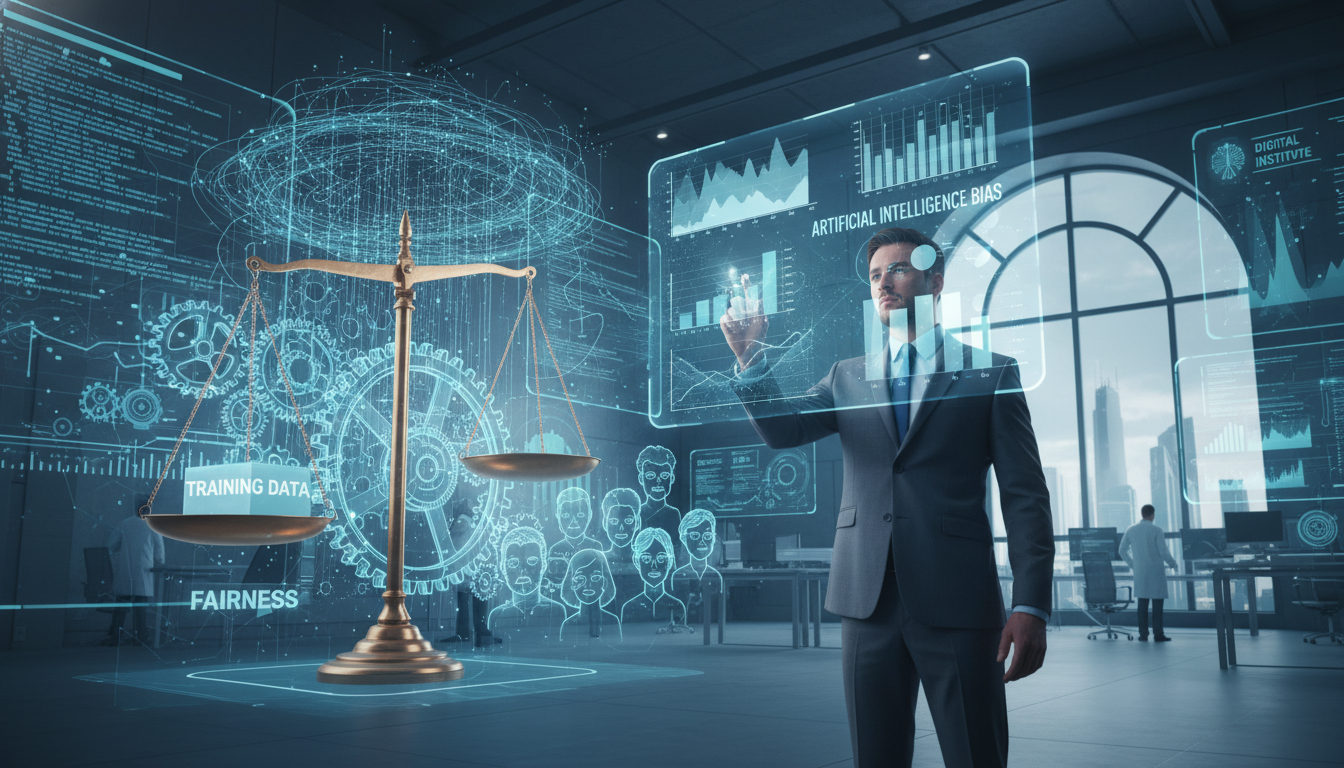
Artificial intelligence (AI) has the potential to reduce certain forms of bias in government decision-making, but it can also introduce or amplify bias if it is poorly designed, trained, or deployed. Whether AI improves fairness depends on the quality of data, the design of the system, human oversight, and ongoing evaluation.
What is bias in government?
Bias is the tendency to treat individuals or groups unfairly because of characteristics such as:
- Race or ethnicity
- Gender
- Age
- Disability
- Religion
- Language
- Geographic location
- Income level
- Political affiliation (where relevant)
- Social or economic status
Bias may be
Explicit bias
Intentional discrimination.
Example:
A law that intentionally excludes a group from receiving a benefit.
Implicit bias
Unconscious preferences or assumptions that affect decisions.
Example:
A hiring manager unknowingly favoring applicants from certain universities.
Systemic bias
Bias embedded in policies, institutions, or historical practices.
Example:
If historical public investment favored some neighborhoods over others, data may reflect those disparities.
How AI can reduce bias
1. Consistent decision-making
Humans can make different decisions based on fatigue, stress, or unconscious bias.
AI can apply the same decision rules consistently to similar cases.
Example:
A government benefits system evaluates all applications using the same published eligibility criteria.
Benefits:
- Greater consistency
- Fewer arbitrary differences
- Faster processing
2. Standardized recruitment
Governments hire millions of employees.
AI can assist by:
- Screening applications based on job-related qualifications.
- Removing identifying information during initial review.
- Ranking candidates according to predefined criteria.
However, AI should support—not replace—human hiring decisions, and systems should be regularly audited to ensure they do not disadvantage qualified applicants from particular groups.
3. Fair resource allocation
Governments distribute:
- Healthcare funding
- Education grants
- Disaster relief
- Social assistance
- Infrastructure budgets
AI can help identify areas of greatest need using objective indicators such as population, poverty rates, or infrastructure condition, rather than relying solely on subjective judgments.
4. Detecting discrimination
AI can analyze large datasets to identify patterns that humans might miss.
Examples include detecting whether:
- Loan approvals differ substantially across comparable groups.
- Tax audits disproportionately affect certain communities.
- Public services have unequal wait times.
This can help agencies investigate whether disparities are justified or require policy changes.
5. Improving public services
AI can help reduce bias by making services more accessible:
- Real-time translation into multiple languages.
- Speech recognition and text-to-speech tools.
- Accessibility features for people with disabilities.
- 24/7 virtual assistants for common government questions.
These capabilities can help reduce barriers for many residents.
6. Fraud detection
Instead of relying on subjective suspicion, AI can identify unusual transaction patterns for further review.
Good practice is for AI to flag cases while trained officials make final decisions, helping reduce arbitrary targeting.
7. Healthcare
Public health agencies can use AI to:
- Identify disease outbreaks.
- Predict hospital demand.
- Allocate vaccines or medical supplies.
- Support diagnosis.
To reduce bias, models should be evaluated across diverse populations to ensure they perform well for different demographic groups.
8. Education
Governments can use AI to:
- Identify students who may need additional support.
- Personalize learning resources.
- Monitor school performance.
- Allocate educational funding.
Models should be monitored to avoid reinforcing historical inequalities.
Examples
Tax administration
AI can:
- Detect suspicious financial patterns.
- Prioritize cases for review.
- Improve consistency in identifying potential fraud.
Human investigators should make final enforcement decisions.
Social welfare
AI can:
- Verify eligibility using available records.
- Identify incomplete applications.
- Estimate processing priorities.
Human review is important, especially when decisions could significantly affect people’s lives.
Transportation
AI can analyze:
- Traffic congestion.
- Accident locations.
- Road conditions.
- Public transit usage.
This information can support more evidence-based infrastructure planning.
Environmental protection
AI can analyze:
- Air quality.
- Water quality.
- Satellite imagery.
- Illegal deforestation.
- Wildlife populations.
This can help governments target inspections and conservation efforts.
Challenges
Despite its potential, AI can also create or worsen bias if
- Training data reflects historical discrimination.
- Some groups are underrepresented in the data.
- Models are evaluated only on average performance rather than across different populations.
- Proxy variables indirectly encode sensitive characteristics.
- Systems are deployed without adequate testing or oversight.
Best practices for governments
Governments deploying AI should aim to:
- Define clear objectives for the system.
- Use representative, high-quality data where possible.
- Test performance across different groups.
- Keep humans involved in high-impact decisions.
- Document how the system works and its limitations.
- Protect privacy and sensitive information.
- Establish accountability for outcomes.
- Monitor systems after deployment and update them as needed.
- Provide channels for people to appeal or challenge decisions.
- Comply with applicable laws and regulations.
Advantages
- More consistent application of rules.
- Faster processing of large volumes of information.
- Ability to identify patterns humans may overlook.
- Improved accessibility for many users.
- Better support for evidence-based policymaking.
- Enhanced ability to detect disparities through data analysis.
Limitations
- AI cannot determine what is “fair” on its own; fairness involves societal, legal, and policy judgments.
- Poor-quality or biased data can lead to biased outcomes.
- Some AI models are difficult to interpret.
- High-stakes decisions often require human judgment and accountability.
- Ongoing maintenance, monitoring, and auditing are necessary.
Conclusion
AI can help governments reduce certain forms of bias by making processes more consistent, identifying disparities in large datasets, and improving access to public services. However, AI is not a guarantee of fairness. Effective use requires careful system design, representative data, regular testing, transparency, human oversight, and mechanisms for accountability and appeal. When these safeguards are in place, AI can be a valuable tool for supporting fairer and more effective government services.