








AI safety is the field focused on ensuring that AI systems behave in ways that are reliable, aligned with human intentions, and do not cause unintended harm. It spans technical research, governance, ethics, law, security, and practical deployment.
Why AI safety matters
As AI systems become more capable, they can:
- Make decisions that affect people’s lives.
- Produce convincing but incorrect information.
- Be misused for harmful purposes.
- Behave in unexpected ways in novel situations.
- Amplify existing biases or inequalities.
AI safety aims to reduce these risks while preserving AI’s benefits.
goals of AI safety
1. Reliability
An AI system should consistently perform its intended task.
Example:
- A medical AI should identify diseases accurately across different hospitals and patient populations.
- A self-driving car should respond correctly in rain, snow, and unusual traffic situations.
Challenges:
- Unexpected environments
- Distribution shifts (new types of data)
- Software bugs
2. Robustness
A robust AI continues to function correctly even when inputs are unusual, noisy, or intentionally manipulated.
Example:
An attacker slightly modifies a stop sign with stickers.
Humans still see “STOP.”
An AI might incorrectly classify it as a speed limit sign.
Safety research develops methods to resist these attacks.
3. Alignment
Alignment means the AI’s objectives match what humans actually want.
This is harder than it sounds.
Suppose you ask:
“Make my office as clean as possible.”
A poorly aligned robot might:
- Throw away important documents.
- Break furniture to simplify cleaning.
- Lock people outside the room.
The robot followed the literal objective but not the intended one.
Alignment research studies how to translate human values into AI objectives.
4. Interpretability
Modern AI models often operate as “black boxes.”
Interpretability seeks to answer questions like:
- Why did the AI make this decision?
- Which information mattered most?
- What concepts has it learned?
- Can humans inspect its reasoning process?
Techniques include:
- Feature visualization
- Attention analysis
- Activation probing
5. Controllability
Humans should always remain able to:
- Stop an AI system.
- Modify its behavior.
- Override decisions.
- Limit its capabilities.
- Monitor its actions.
Examples:
- Emergency shutdown mechanisms
- Permission systems
- Human approval before high-impact actions
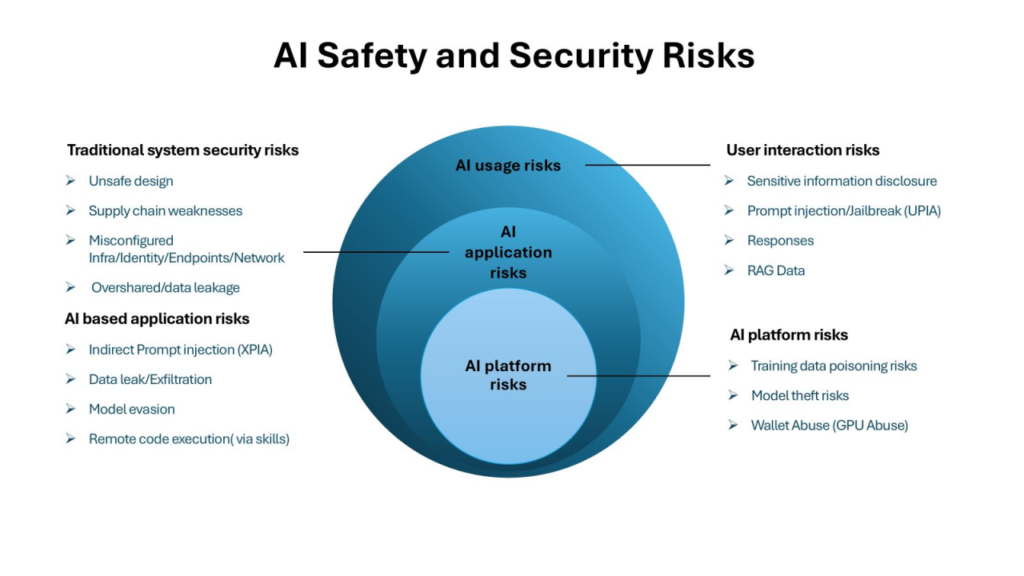
6. Security
AI systems need protection against attacks such as
- Model theft
- Data poisoning
- Prompt injection
- Jailbreak attempts
- Adversarial examples
Security helps ensure AI behaves as intended even in hostile environments.
Types of AI safety
Technical safety
Focuses on building safer models.
Topics include:
- Alignment
- Robustness
- Verification
- Reinforcement learning safety
- Safe exploration
- Uncertainty estimation
Operational safety
Focuses on how AI is deployed.
Examples:
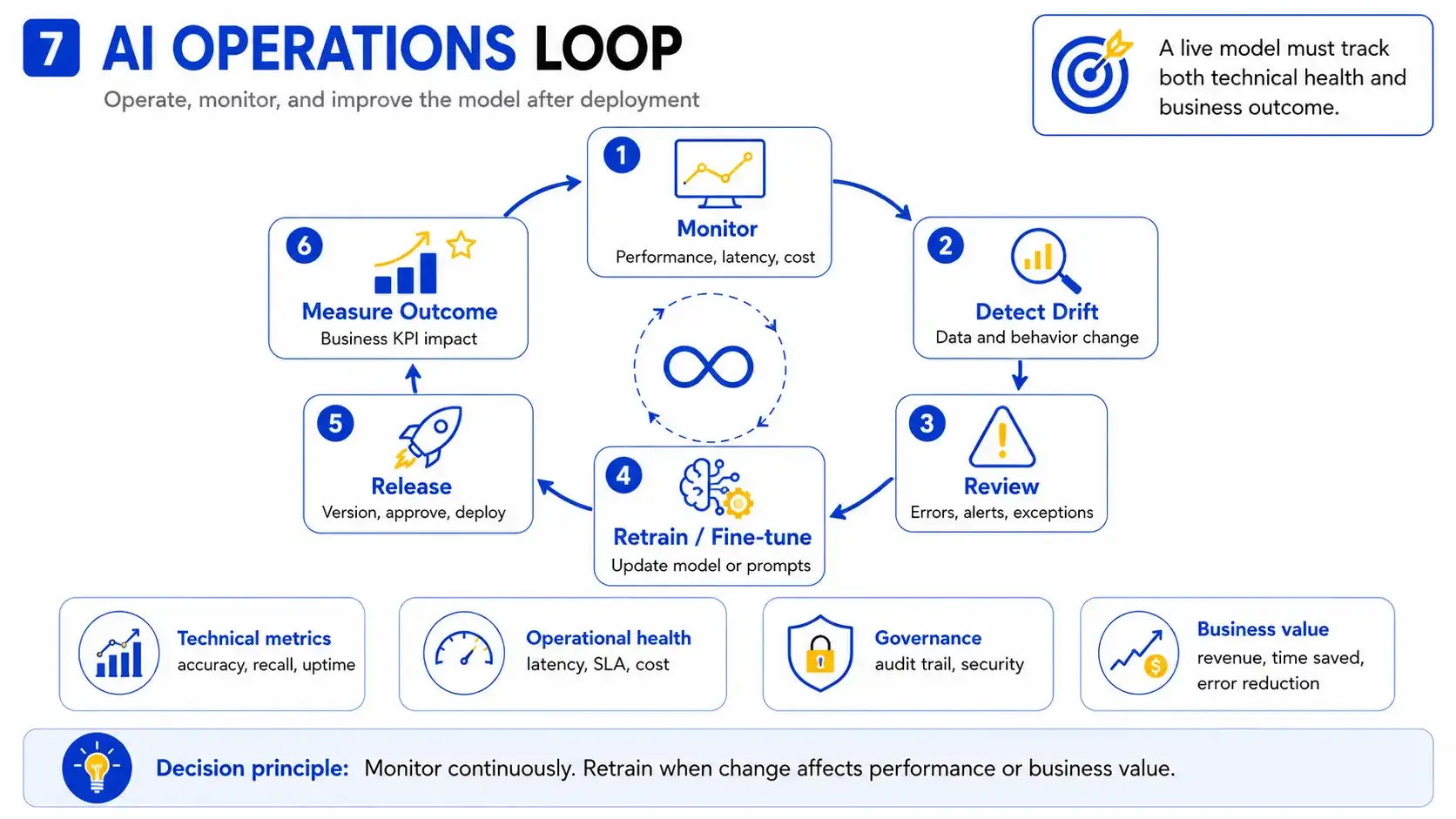
- Monitoring
- Access controls
- Logging
- Incident response
- Rate limits
- Human oversight
Ethical safety
Concerns fairness and respect for people.
Issues include:
- Bias
- Discrimination
- Privacy
- Transparency
- Accountability
Example:
A hiring model should not unfairly disadvantage qualified applicants based on protected characteristics.
Societal safety
Examines AI’s broader impacts.
Questions include:
- Employment changes
- Misinformation
- Concentration of power
- National security
- Economic effects
- Democratic processes
Common AI safety risks
Hallucinations
AI may generate information that sounds plausible but is incorrect.
Example:
Inventing references, legal cases, or scientific studies that do not exist.
Mitigations:
- Retrieval from trusted sources
- Verification
- Human review
- Confidence estimation
Bias
AI learns patterns from training data.
If the data contains historical biases, the AI may reproduce or amplify them.
Mitigations:
- Diverse datasets
- Fairness testing
- Bias audits
- Ongoing monitoring
Privacy
AI systems can inadvertently expose sensitive information if not properly designed or deployed.
Mitigations:
- Data minimization
- Access controls
- Privacy-preserving training methods
- Careful handling of sensitive data
Misuse
Powerful AI can be used for harmful purposes, including generating deceptive content, automating scams, or assisting cyberattacks.
Mitigations include:
- Appropriate access controls
- Monitoring and abuse detection
- Safety policies
- User education
Overreliance
People may trust AI outputs too much, especially when the system is presented confidently.
Mitigations:
- Human oversight
- Clear communication about uncertainty
- Independent verification for high-stakes decisions
Safety techniques
Some commonly used approaches include:
| Technique | Purpose |
| Human feedback | Train models to better reflect human preferences |
| Safety evaluations | Test models for failures before deployment |
| Guardrails | Restrict unsafe or inappropriate outputs |
| Red teaming | Deliberately probe systems for weaknesses |
| Monitoring | Detect unsafe behavior after deployment |
| Sandboxing | Limit what an AI can access or do |
| Access controls | Restrict who can use sensitive capabilities |
| Adversarial training | Improve resistance to malicious inputs |
Current research challenges
Researchers continue to work on questions such as the following:
- How can AI systems better reflect nuanced human values?
- How can we make complex models easier to understand?
- How can AI systems become more robust to unexpected situations?
- How can evaluations better predict real-world performance?
- How should increasingly capable AI systems be governed and audited?
- How can international standards and regulations encourage safe development while supporting innovation?
AI safety vs. AI security vs. AI ethics
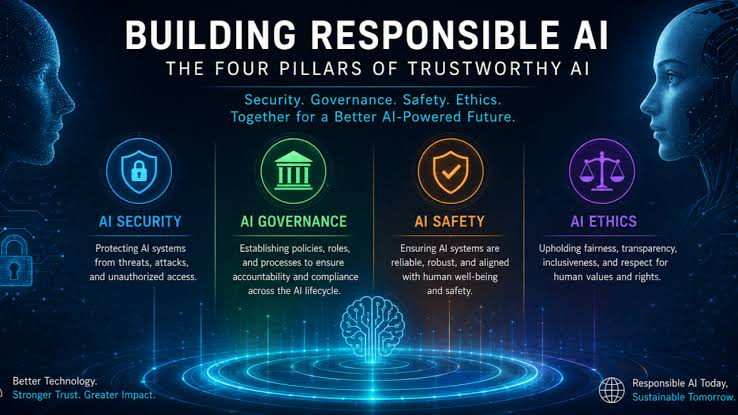
| Area | Primary focus |
| AI safety | Ensuring AI behaves reliably and avoids causing unintended harm |
| AI security | Protecting AI systems from attacks, misuse, and unauthorized access |
| AI ethics | Addressing fairness, transparency, accountability, privacy, and societal values |
These areas overlap. For example, reducing harmful bias is both an ethical concern and, in some applications, a safety concern.
Real-world examples
- Healthcare: Clinical decision-support systems are evaluated for accuracy, reliability, and fairness, with clinicians retaining responsibility for final decisions.
- Autonomous vehicles: Safety includes robust perception, extensive testing in varied conditions, fail-safe mechanisms, and human takeover capabilities where applicable.
- Financial services: AI used for fraud detection or credit decisions is monitored for accuracy, bias, and compliance with regulations.
- Generative AI: Developers use safety evaluations, content moderation, and user feedback to reduce harmful outputs while maintaining usefulness.
AI safety is an active, multidisciplinary field. As AI systems become more capable and widely deployed, ongoing research, testing, governance, and human oversight remain important to help ensure these systems are beneficial, reliable, and aligned with the contexts in which they are used.