
What Does CAIO Mean?
A chief AI officer is referred to as a CAIO. It’s a new executive position where one person owns all of the AI in a corporation; it didn’t truly exist a few years ago. Everything from strategy to adoption to governance to integrations.
This title keeps coming up. Given how important AI has grown, it makes logical sense. I’ve written about why CTOs should be the first to own AI if you’re a CTO considering this.
How Can a CAIO Be Obtained?
There are two choices available to you.
Encourage internal promotion. Your CTO can advance into the position if they have a sincere interest in AI and have been leading it anyhow. Benefit: They are familiar with your data, systems, and limitations. Risk: Instead of prioritizing AI, they might continue to think like a CTO. old customs.
Employ external candidates. brings committed AI experience and a new viewpoint. But exercise caution—two years ago, this position hardly existed. Anybody who says they have ten years of CAIO experience is lying. Instead of recruiting someone with the exact title, what you’re really looking for is someone who has led AI programs at scale.
CAIO vs. CTO vs. CIO
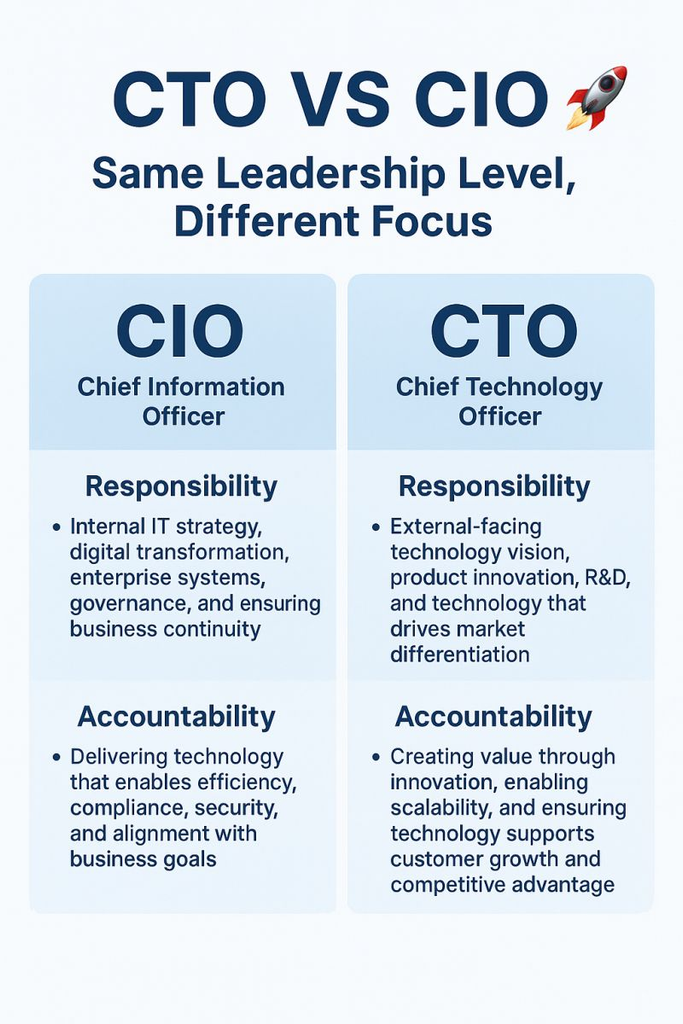
| Aspect | CTO | CIO | CAIO |
| Main Focus | Engineering & Architecture | IT Systems & Operations | AI Strategy & Adoption |
| AI Priority | One of many priorities | One of many priorities | Core priority |
| Typical Background | Engineering & Technology Leadership | IT & Operations Leadership | AI/ML, Data Science, or Technology Leadership |
| Best For | Technical innovation & product delivery | Enterprise IT & Digital Operations | Organization-wide AI Transformation |
When are both a CTO and a CAIO necessary?
One person can take on both roles in smaller businesses. AI is added to the CTO’s duties. That works until AI becomes so important that it merits exclusive attention, or until the CTO has too much on their plate to devote the necessary time to AI.
They are frequently seen as distinct responsibilities in larger organizations. The CTO is in charge of delivery, architecture, and technical organization. AI strategy, governance, and transformation are under the purview of the CAIO. They work together, yet they have distinct priorities.
Some organizations divide it differently, with a VP of Engineering taking up the typical CTO responsibilities and the CTO becoming the CAIO. The same person has a different title.
Do You Require One?
Not everyone does; your CTO or tech lead may be the owner of AI if your company employs 20 people. Another C-level title is not necessary.
However, having someone whose whole job is AI starts to make sense if AI is becoming essential to your competitive strategy or if you’ve seen AI efforts occurring in silos throughout the organization without coordination. The same applies if you operate at a size where governance and compliance are truly complex.
Fractional CAIO: The Option for Part-Time Work
Not prepared to hire a chief AI officer on a full-time basis? The solution could be a fractional CAIO.
The idea is similar to that of a fractional CTO: you receive senior AI leadership on a part-time basis. Perhaps a certain number of hours per month, or one or two days per week. Without the full-time executive compensation, they oversee your team, establish governance, and own the AI strategy.
This is effective when:
AI is crucial for your mid-sized company (50–200 employees), but not for your whole enterprise.
Someone is needed to provide guidance and improve the skills of your current staff.
Before committing, you should determine whether a full-time CAIO makes sense.
How to Become a CAIO
Here’s the route if you’re a CTO considering transitioning into this position.
1. Take control of AI right away. Don’t wait for approval. Even if it’s not your official job, take the effort to work on AI initiatives. Establish a track record.
2. Acquire business knowledge. CAIOs must link AI to business benefit rather than just technical prowess. Recognize income, expenses, and competitive positioning. Where does AI make a difference?
3. Gain experience in governance. Data security, GDPR for AI systems, and the AI Act are all becoming increasingly important aspects of the job. Start learning about compliance if you’ve just worked on the exciting technical aspects.
4. Establish connections across functional boundaries. Every department is impacted by AI. You will have to collaborate with product, marketing, legal, and human resources. Now is the time to begin creating those bridges.
5. Become visible. In discussions with leaders, discuss AI strategy. Write about it. Make a presentation to the board. Make sure others are aware that you are already working as a CAIO.
Competencies a CAIO Requires
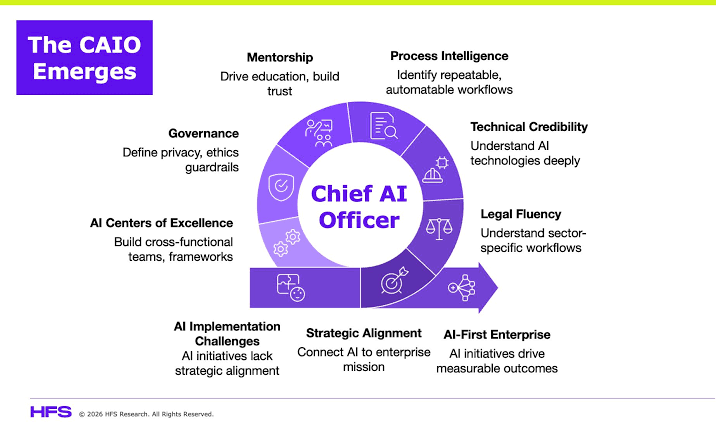
A Chief AI Officer (CAIO) requires a combination of business strategy, leadership, governance, and AI expertise.
AI & Machine Learning: Learn about automation, generative AI, AI models, and new technologies.
Company Strategy: Link AI projects to revenue, growth, efficiency, and company objectives.
Know data governance, privacy, analytics, and quality.
Managing AI risks, ethics, security, compliance, and responsible AI use is known as AI governance.
Leadership: Oversee cross-functional AI teams and promote adoption throughout the whole company.
Change management: Assist executives and staff in adjusting to AI-driven processes.
Technical Knowledge: Collaborate well with software, cloud, IT, and engineering teams.
Communication: Clearly explain complicated AI ideas to stakeholders, executives, and staff.
Innovation: Determine useful applications for AI and assess novel AI tools and technology.
Conclusion
The chief AI officer (CAIO) is becoming an important leadership role as organizations integrate AI into their operations, products, and long-term strategies. A CAIO combines AI knowledge with business leadership to identify valuable opportunities, manage AI risks, and ensure responsible adoption.
While the role may overlap with the CTO or CIO, the CAIO’s primary focus is driving AI strategy and transformation across the organization. As AI continues to evolve, businesses that have strong AI leadership will be better positioned to innovate, improve efficiency, and remain competitive.