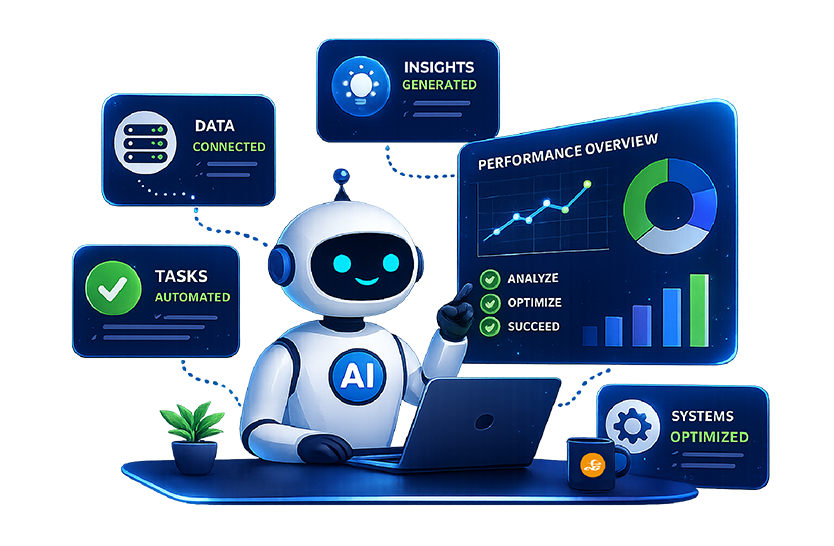
AI monitoring provides teams with real-time insight into the performance of AI models in production through metrics, logs, and traces. It includes everything from resource use and model correctness to cost tracking and API latency. Early problem detection, performance optimization, and upholding confidence in AI-driven results are the objectives.
The continuous process of tracking, evaluating, and understanding the behavior and performance of AI systems is known as AI monitoring. AI monitoring, in contrast to standard application monitoring, has to deal with the particular complexity of machine learning models, which depend on dynamic data streams and APIs, might drift in accuracy, and require substantial computational resources.
Monitoring these systems is more important than ever since businesses are depending more and more on artificial intelligence (AI) to automate decisions, streamline processes, and spur innovation. AI monitoring aims to maintain the accuracy, safety, and dependability of AI-driven choices over time in addition to tracking performance.
Why is AI monitoring crucial?
Artificial intelligence systems are not disposable. As usage patterns change, surroundings change, and data changes, so does their behavior. Without ongoing observation, businesses run the risk of the following:
Performance degradation: When input data changes, models may become less accurate (a phenomenon known as model drift).
Resource waste: Unoptimized models may use too much memory, CPU, or GPU, which raises expenses.
Unreliable decisions: Poor business consequences and reputational damage can result from mistakes, biases, or hallucinations in AI outputs.
Compliance risks: There may be legal repercussions if bias, impartiality, or data privacy are not monitored.
Essential elements of a successful AI monitoring plan
Monitoring AI effectively entails more than just keeping an eye on system health. It entails monitoring, evaluating, and acting upon data throughout the entire AI workflow. Every element is essential to maintaining the accuracy, dependability, and affordability of AI systems.
Performance of the Model
As fresh data becomes available and business requirements change, AI models evolve. Teams must monitor important parameters like accuracy, precision, recall, and F1 score in order to maintain models’ accuracy. Continuous monitoring aids in identifying changes early on if a model begins to drift or if its forecasts become less accurate. In order to maintain the model’s alignment with actual data, teams can then initiate retraining or make adjustments. Monitoring is essential for ethical AI since it detects bias or unjust results. Teams may automate workflows and alerts by integrating model performance data with analytics and monitoring tools, ensuring that models remain reliable and compliant.
Utilization of Resources and Infrastructure
AI models require a lot of processing power to run: CPUs, GPUs, memory, and network bandwidth are all consumed. Models may lag or even crash if resources are depleted or overburdened. Teams can see the health of the system clearly and prevent expensive outages by keeping an eye on these resources. Additionally, it enables teams to identify resource-wasting inefficiencies or misconfigurations. Organizations can balance cost and performance by scaling resources up or down as needed with real-time monitoring. establishing connections with systems for performance analytics, which provide teams with a cohesive perspective on the state of infrastructure.
Monitoring of APIs and Services
AI models are connected to consumers and other systems via APIs. Users immediately notice if APIs become sluggish or begin to generate errors. Teams may maintain the smooth operation of services by keeping an eye on API performance metrics, including latency, error rates, and throughput. Teams may define criteria and automate warnings with the aid of dashboard and visualization tools, ensuring that problems are resolved before they impact users.
New Developments and AI Monitoring’s Future
Organizational monitoring of AI is rapidly evolving. Monitoring must keep up with the increasing use of AI in cloud data centers and distant edge devices. One significant change is toward federated monitoring, in which monitoring technologies keep an eye on AI models operating on edge devices or in numerous locations. In sectors like manufacturing or healthcare, where data must be handled close to its source for speed and privacy, this is particularly crucial. Teams can see what’s going on everywhere, not just in the main data center, thanks to federated monitoring.
Another emerging concept is edge AI monitoring. AI models operating on edge devices, such as factory sensors or smart cameras, require monitoring to function even in situations when internet connectivity is inconsistent or nonexistent. Because edge monitoring solutions are lightweight, they don’t cause devices to lag or consume excessive amounts of power. Additionally, they support the localization of sensitive data, which is crucial for compliance and privacy.
Workflows for automated retraining are also growing in popularity. Monitoring tools can identify when a model’s performance begins to decline and initiate a retraining procedure automatically, eliminating the need to wait for planned retraining. As data patterns shift, this maintains models’ accuracy and dependability. These procedures are simple to coordinate because to integration with AIOps systems, so teams on
Monitoring must manage multimodal data, such as text, photos, and video, simultaneously as AI systems become more sophisticated. In order to ensure that nothing is overlooked, monitoring systems must check data quality and performance across various formats. With monitoring tools tracking requests and answers across networks of linked models, multi-model orchestration is also becoming more popular. When something goes wrong, this helps with root cause analysis and provides teams with end-to-end insight.
AI monitoring will get increasingly autonomous and predictive in the future. Monitoring systems will be able to identify problems before they impact users thanks to advanced analytics and machine learning, which will initiate automated corrections or retraining. AI monitoring will become much more integrated with AIOps, moving from reactive to proactive. This implies that businesses can maintain their AI systems.