








Introduction
Artificial intelligence (AI) is rapidly transforming the global food industry, enabling businesses to reduce waste, accelerate innovation, and make smarter, data-driven decisions. While generative AI has attracted widespread attention through chatbots and virtual assistants, its impact extends far beyond conversational tools. Today, AI is reshaping every stage of the food value chain—from ingredient discovery and product formulation to regulatory compliance, research and development (R&D), supply chain optimization, quality assurance, and personalized nutrition.
As AI adoption accelerates, food manufacturers, retailers, and technology providers are exploring how these technologies can improve efficiency, sustainability, and resilience while addressing growing consumer expectations and regulatory demands. At the same time, important questions remain: What business challenges can AI solve today? Where are its practical limitations? And how can organizations implement AI responsibly while maintaining transparency, food safety, and human oversight?
Industry experts increasingly agree that the greatest value of AI lies not in replacing human expertise but in enhancing it. By automating repetitive tasks, uncovering insights from complex data, and supporting faster decision-making, AI enables food scientists, supply chain managers, quality assurance teams, and business leaders to focus on innovation and strategic problem-solving. As the technology continues to evolve, AI is poised to become a critical enabler of a more efficient, sustainable, and consumer-centric global food system.
AI as the New Orchestrator of Nutrition, Health, and Food Systems
Artificial intelligence (AI) is emerging as a powerful orchestrator of the modern food ecosystem, connecting nutrition science, public health, food production, and supply chain operations through data-driven intelligence. Rather than functioning as a standalone technology, AI integrates vast amounts of information from agriculture, food manufacturing, healthcare, consumer behavior, and environmental monitoring to enable smarter, faster, and more sustainable decision-making across the entire food value chain.
Traditionally, nutrition, healthcare, agriculture, and food manufacturing have operated as separate systems with limited data sharing. This fragmentation often results in inefficiencies, food waste, inconsistent nutritional outcomes, delayed innovation, and supply chain disruptions. AI is helping bridge these gaps by transforming disconnected datasets into actionable insights that support collaboration between stakeholders, including farmers, food manufacturers, healthcare providers, retailers, researchers, and policymakers.
One of AI’s most significant contributions is its ability to personalize nutrition. By analyzing individual health data, dietary habits, genetic information, wearable device data, and lifestyle factors, AI can recommend personalized diets that support disease prevention and overall well-being. Healthcare professionals can leverage these insights to create nutrition plans tailored to patients with chronic conditions such as diabetes, obesity, cardiovascular disease, and food allergies, moving beyond generalized dietary guidelines toward precision nutrition.
AI is also accelerating innovation in food research and development (R&D). Machine learning models can analyze thousands of ingredient combinations, predict sensory characteristics, optimize nutritional profiles, and identify sustainable alternatives to traditional ingredients. This significantly reduces product development cycles, enabling food companies to respond more quickly to evolving consumer preferences for healthier, plant-based, and environmentally responsible products.
Across food manufacturing, AI improves operational efficiency by monitoring production processes in real time. Intelligent systems can detect equipment anomalies, optimize manufacturing parameters, predict maintenance needs, and identify quality issues before products leave the production line. Computer vision technologies further enhance food safety by automatically inspecting products for defects, contamination, labeling errors, and packaging inconsistencies, helping manufacturers maintain consistent quality while minimizing waste.
Supply chains have become increasingly complex due to globalization, climate change, geopolitical uncertainty, and shifting consumer demand. AI strengthens supply chain resilience by forecasting demand, optimizing inventory levels, identifying potential disruptions, and recommending alternative sourcing strategies. Predictive analytics enables businesses to reduce overproduction, minimize food loss, and improve delivery efficiency while maintaining product availability.
Food safety and regulatory compliance also benefit from AI-driven intelligence. Advanced algorithms continuously monitor production data, supplier records, laboratory testing results, and regulatory requirements to identify potential compliance risks. AI can automate documentation, support traceability initiatives, and accelerate product recalls by rapidly identifying affected batches, improving transparency throughout the food supply chain.
Sustainability has become another major area where AI delivers measurable value. By analyzing agricultural conditions, weather patterns, water usage, soil health, and energy consumption, AI helps optimize resource utilization and reduce environmental impact. Farmers can implement precision agriculture techniques that apply fertilizers, pesticides, and irrigation only where needed, while manufacturers can improve energy efficiency and reduce greenhouse gas emissions throughout production and distribution.
Designing Molecules with AI: A New Era of Food R&D
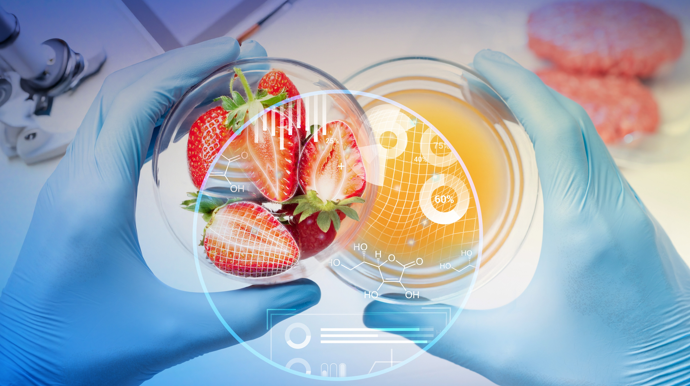
Artificial intelligence (AI) is transforming food research and development (R&D) by enabling scientists to design and evaluate food molecules with unprecedented speed and precision. Traditionally, discovering new ingredients, optimizing formulations, or improving nutritional profiles required years of laboratory experiments, extensive trial and error, and significant financial investment. Today, AI is accelerating this process by analyzing massive datasets, predicting molecular behavior, and identifying promising compounds before they enter the laboratory.
At the core of this transformation is AI’s ability to model complex biological and chemical interactions. Machine learning algorithms can examine the molecular structures of proteins, fats, carbohydrates, flavor compounds, and bioactive ingredients to predict how they will behave during processing, storage, and consumption. This allows researchers to screen thousands of potential molecules virtually, reducing the number of costly physical experiments required.
Accelerating Ingredient Discovery
One of the most significant applications of AI in food R&D is the discovery of novel ingredients. AI can analyze vast databases of plant compounds, microbial metabolites, and naturally occurring molecules to identify ingredients with desirable functional or nutritional properties. Researchers can rapidly explore alternatives to traditional ingredients, helping manufacturers develop healthier, more sustainable products without compromising taste or texture.
For example, AI can identify plant proteins with improved emulsification, foaming, or gelling properties, making them suitable replacements for animal-derived ingredients in dairy alternatives, meat substitutes, and functional beverages.
Predicting Flavor and Texture
Consumer acceptance depends heavily on flavor, aroma, and texture. AI models trained on sensory data can predict how different molecules interact to influence taste and mouthfeel. By simulating these interactions before product development begins, researchers can optimize formulations more efficiently and reduce reliance on repeated sensory trials.
AI can also recommend ingredient combinations that maintain flavor while reducing sugar, salt, or fat content, enabling manufacturers to create healthier products that still meet consumer expectations.
Enhancing Nutritional Quality
AI is enabling a new generation of nutrient-focused product development by identifying ingredient combinations that maximize nutritional value. Algorithms can evaluate the bioavailability of vitamins, minerals, proteins, and other nutrients while considering processing conditions that may affect their stability.
This capability supports the development of foods tailored to specific dietary needs, including products designed for children, older adults, athletes, or individuals managing chronic health conditions. By combining nutritional science with predictive analytics, AI helps create products that deliver both health benefits and consumer appeal.
Supporting Precision Fermentation and Alternative Proteins
The growing demand for sustainable protein sources has increased interest in precision fermentation and cultivated ingredients. AI plays a critical role by designing microbial strains, optimizing fermentation conditions, and predicting protein structures that improve functionality and production efficiency.
Researchers can use AI to identify microorganisms capable of producing specific proteins, enzymes, flavors, or nutritional compounds while optimizing growth conditions to maximize yield and reduce production costs. This accelerates innovation in alternative proteins and next-generation food ingredients.
Improving Formulation Efficiency
Developing a new food product often requires balancing dozens of variables, including ingredient compatibility, processing conditions, shelf life, nutritional content, cost, and regulatory requirements. AI can evaluate these variables simultaneously, recommending optimized formulations that meet multiple objectives.
For example, when reformulating a snack product to reduce sodium, AI can identify alternative ingredients that preserve flavor, texture, and shelf stability while complying with nutritional guidelines. This shortens development timelines and minimizes costly reformulation cycles.
Reducing Time and Cost in Product Development
Traditional food R&D can take months or even years to move from concept to commercialization. AI significantly compresses this timeline by automating data analysis, prioritizing promising formulations, and identifying potential challenges early in the development process.
Instead of testing hundreds of physical prototypes, researchers can use AI to evaluate virtual formulations and focus laboratory resources on the most promising candidates. This reduces development costs, accelerates innovation, and enables companies to respond more quickly to changing market trends.
Advancing Sustainable Food Innovation
Sustainability has become a major driver of food innovation, and AI supports this goal by helping researchers identify environmentally friendly ingredients and production methods. AI models can estimate the environmental impact of different formulations, including greenhouse gas emissions, water use, land requirements, and energy consumption.
These insights allow companies to design products with lower environmental footprints while maintaining nutritional quality and consumer satisfaction, supporting broader sustainability and climate objectives.
Challenges and Considerations
Despite its transformative potential, AI is not a substitute for scientific validation. Predictions generated by AI must be confirmed through laboratory testing, sensory evaluation, safety assessments, and regulatory review. The quality of AI-generated recommendations depends on the availability of accurate, diverse, and representative datasets, making high-quality data management essential.
Organizations must also address issues related to data privacy, intellectual property, model transparency, and regulatory compliance to ensure that AI-driven innovation remains responsible and trustworthy.
The Future of AI-Driven Food R&D
As AI technologies continue to evolve, food R&D will become increasingly predictive, data-driven, and collaborative. Researchers will be able to simulate ingredient interactions, optimize formulations, and evaluate product performance before physical development begins, dramatically reducing innovation cycles.
Rather than replacing food scientists, AI will augment their expertise by providing deeper insights, accelerating discovery, and enabling more informed decision-making. This partnership between human creativity and artificial intelligence is ushering in a new era of food innovation—one where healthier, more sustainable, and consumer-centric products can be developed faster than ever before.
Conclusion
Artificial intelligence is no longer an emerging technology on the periphery of the food industry—it is rapidly becoming the infrastructure that powers innovation across the entire food ecosystem. From designing novel ingredients and accelerating research and development to optimizing supply chains, enhancing food safety, enabling personalized nutrition, and improving sustainability, AI is reshaping how food is developed, produced, distributed, and consumed.
What distinguishes AI from previous digital technologies is its ability to transform vast amounts of fragmented data into actionable insights. Rather than functioning as a standalone tool, AI connects scientists, manufacturers, retailers, healthcare professionals, and consumers through intelligent systems that support faster, more informed decision-making. This integration enables organizations to respond more effectively to evolving consumer preferences, regulatory requirements, and global challenges such as climate change, food security, and resource constraints.
However, the future of food innovation will not be driven by AI alone. Human expertise remains essential for scientific discovery, ethical decision-making, product validation, and regulatory compliance. The greatest value of AI lies in augmenting human capabilities—automating repetitive tasks, uncovering hidden patterns, and providing predictive insights that allow experts to focus on creativity, strategy, and innovation.
As AI technologies continue to mature, organizations that embrace responsible adoption will be better positioned to develop healthier products, reduce waste, improve operational efficiency, and build more resilient food systems. Success will depend not only on investing in advanced algorithms but also on ensuring high-quality data, transparent governance, interdisciplinary collaboration, and a commitment to responsible innovation.
The future of food will be shaped by intelligent, connected systems where every stage of the value chain—from farm to factory, laboratory to retail shelf, and nutrition to healthcare—is informed by real-time data and AI-driven intelligence. Organizations that recognize AI as a foundational capability rather than simply another digital tool will lead the next generation of food innovation, delivering safer, more sustainable, and more personalized food solutions for a growing global population.