
Contingent workforce compliance is the process of ensuring that businesses legally engage, classify, pay, manage, and protect nontraditional workers such as independent contractors, freelancers, temporary workers, consultants, and staffing-agency workers.
Compliance is important because contingent workers can be subject to different legal requirements depending on their classification, location, contract, and actual working relationship.
What Is Contingent Workforce Compliance?
A contingent workforce typically consists of workers who are not part of an organization’s traditional permanent employee workforce. The EEOC describes contingent workers as people whose jobs may be limited in duration, sporadic, or otherwise different from standard full-time employment.
Contingent workforce compliance involves managing areas such as:
- Worker classification
- Contracts and documentation
- Payroll and taxes
- Wage and hour requirements
- Benefits and protections
- Workplace safety
- Equal employment obligations
- Data security
- Background checks
- Vendor and staffing-agency relationships
- Recordkeeping and audits
Why Is Contingent Workforce Compliance Important?
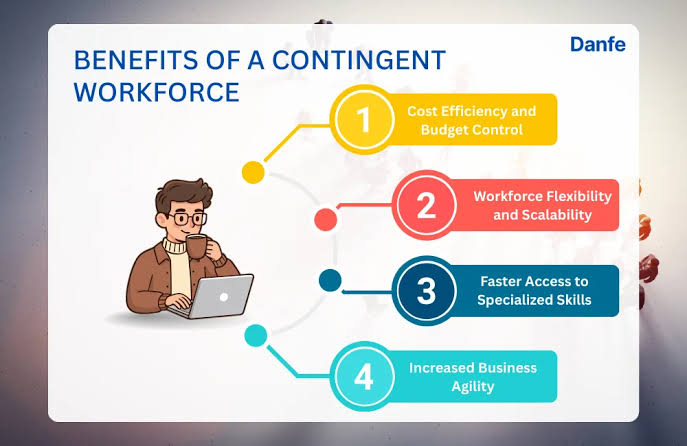
Businesses often use contingent workers to gain flexibility, access specialized skills, or respond to changing workforce demands. However, treating a worker incorrectly can create significant legal and financial exposure.
For example, under U.S. federal law, an employee who is incorrectly treated as an independent contractor may lose protections such as minimum wage and overtime rights. The Department of Labor considers misclassification a serious issue.
The IRS also notes that businesses that incorrectly classify employees as independent contractors may become liable for employment taxes.
Key Areas of Contingent Workforce Compliance
1. Worker Classification
Worker classification is one of the most important compliance issues.
A company should not rely solely on a worker’s job title, contract, or the parties’ agreement. Under the U.S. Department of Labor’s FLSA framework, classification depends on the economic reality of the working relationship.
As of 2026, the Department of Labor has proposed a new rule that would replace its 2024 independent-contractor rule. The February 2026 proposal identifies five non-exhaustive economic-reality factors and gives particular weight to control and opportunity for profit or loss.
The proposed factors are:

- Nature and degree of control
- Opportunity for profit or loss
- Skill required
- Permanence of the relationship
- Whether the work is part of an integrated unit of production
Important: This 2026 framework is a proposed rule, not a universal classification standard. Other federal, state, and local laws can use different tests.
2. Contracts and Documentation
Businesses should maintain clear agreements describing:
- Scope of work
- Deliverables
- Payment terms
- Project duration
- Confidentiality
- Intellectual property
- Insurance requirements
- Termination provisions
- Responsibilities of each party
However, a contract alone does not determine worker classification. Actual working practices can matter more than contractual labels under applicable laws.
3. Payroll and Tax Compliance
Businesses need to understand the tax consequences associated with each type of contingent worker.
For independent contractors, organizations generally have different reporting and withholding responsibilities than they do for employees. Incorrect classification can create employment-tax liabilities.
4. Wage and Hour Compliance
If a contingent worker is legally an employee, applicable wage-and-hour protections must be followed.
Under the FLSA, covered employees generally receive protections involving minimum wage, overtime, recordkeeping, and child labor.
5. Equal Employment and Anti-Discrimination Compliance
Contingent workers can also raise equal-employment issues, particularly when staffing agencies and client companies share responsibility for workplace conditions.
The EEOC specifically addresses the application of federal equal-employment laws to contingent workers placed by temporary employment agencies and staffing firms.
6. Workplace Safety
Companies should make sure contingent workers receive appropriate safety information, training, equipment, and workplace protections applicable to their roles.
Safety obligations can depend on the industry, worker classification, staffing arrangement, and applicable jurisdiction.
7. Data and Cybersecurity
Contingent workers may receive access to:
- Customer information
- Company systems
- Financial information
- Internal documents
- Intellectual property
- Business applications
A compliance program should therefore include appropriate access controls, confidentiality requirements, account management, and offboarding procedures.
Common Contingent Workforce Compliance Risks
Misclassification
The company treats an employee as an independent contractor.
Co-Employment Risk
A staffing agency may technically employ a worker while the client company controls aspects of the worker’s day-to-day activities. This can create questions about which organization has particular legal responsibilities.
Poor Documentation
Missing contracts, classification records, time records, or vendor documentation can make compliance audits more difficult.
Inconsistent Classification
Workers performing substantially similar jobs may be classified differently without a documented reason.
Failure to Monitor Laws
Classification and employment requirements can differ between federal, state, and local jurisdictions. The DOL specifically notes that its proposed 2026 FLSA analysis would not replace other classification standards under laws such as the Internal Revenue Code, NLRA, or certain state wage laws.
How to Build a Contingent Workforce Compliance Program

A practical program can follow these steps:
1. Identify all contingent workers
Create a complete inventory of contractors, freelancers, temporary workers, consultants, and staffing-agency workers.
2. Determine the applicable classification rules
Review federal, state, local, and industry-specific requirements.
3. Conduct classification assessments
Evaluate the actual working relationship rather than relying only on job titles or contracts.
4. Standardize contracts
Use appropriate agreements and clearly document responsibilities.
5. Maintain records
Keep classification decisions, contracts, invoices, payments, and relevant compliance documentation.
6. Control system access
Give contingent workers only the access required for their assignments.
7. Monitor staffing vendors
Review staffing agencies and other third-party providers for appropriate compliance practices.
8. Audit regularly.
Reassess worker relationships as projects, responsibilities, locations, and working arrangements change.
Benefits of Strong Compliance
A well-managed contingent workforce compliance program can help organizations:
- Reduce misclassification risk
- Improve workforce visibility
- Protect worker rights
- Strengthen vendor management
- Improve documentation
- Reduce tax and payroll problems
- Protect company data
- Create consistent workforce processes
- Support scalable hiring
Contingent Workforce Compliance Checklist
| Compliance Area | What to Review |
| Classification | Employee vs. independent contractor |
| Contracts | Scope, payment, confidentiality, responsibilities |
| Taxes | Reporting and employment-tax obligations |
| Wages | Minimum wage and overtime, where applicable |
| Safety | Training and workplace protections |
| EEO | Applicable anti-discrimination requirements |
| Data security | System access and confidential information |
| Vendors | Staffing-agency compliance |
| Records | Contracts, assessments, payments, and documentation |
| Audits | Periodic compliance reviews |
Conclusion
Contingent workforce compliance is essential for organizations that depend on contractors, freelancers, temporary workers, and staffing agencies. The most important areas are correct worker classification, clear contracts, tax and wage compliance, workplace protections, data security, documentation, and ongoing audits.
For U.S. businesses in particular, classification rules are currently an area of regulatory change: the Department of Labor issued a February 2026 proposed rule that would revise its FLSA analysis of employee versus independent-contractor status. Because the proposal does not govern every other federal, state, or local classification law, businesses should evaluate the rules applicable to each worker and jurisdiction.