
Smart Semantic Relevance with AI
“Smart Semantic Relevance with AI” refers to using artificial intelligence to understand the meaning, context, relationships, and intent behind online content. Instead of focusing only on exact keywords, AI helps search engines and content creators identify how different words, topics, entities, and concepts are connected.
What Is Semantic Relevance?
Semantic relevance measures how closely a piece of content matches the meaning and intent behind a search query. For example, a page about “artificial intelligence in healthcare” may be semantically relevant to terms such as machine learning, predictive analytics, medical diagnosis, healthcare automation, and patient data—even when those exact phrases are not repeated frequently.
How AI Improves Semantic Relevance
AI makes semantic analysis more accurate by processing large amounts of language and identifying relationships between concepts. It can help:
- Understand search intent
- Identify related topics and entities
- Recognize synonyms and contextual meanings
- Analyze content structure
- Find gaps in existing content
- Suggest relevant keywords and topics
- Improve internal linking opportunities
- Create more contextually complete content
Benefits of Smart Semantic Relevance with AI
1. Better Search Visibility
AI can help create content that covers a topic comprehensively, making it more relevant to different variations of user searches.
2. Stronger Content Quality
Rather than repeating keywords, writers can focus on answering related questions and providing useful information.
3. Improved Search Intent Matching
AI can analyze whether users are looking for information, products, comparisons, instructions, or solutions and help align content with that intent.
4. More Relevant Content Ideas
AI can identify related concepts, questions, subtopics, and entities that can strengthen an article.
5. Smarter Internal Linking
Semantic relationships can help identify which pages and topics naturally connect, creating a stronger website content structure.
Example
Suppose the main topic is “AI in Digital Marketing.” Smart semantic relevance would go beyond repeating the phrase “AI in digital marketing.” Related concepts could include:
- AI content creation
- Marketing automation
- Predictive analytics
- Customer personalization
- Chatbots
- SEO automation
- Generative AI
- Customer behavior analysis
Covering these connected concepts naturally can make the content more comprehensive and contextually relevant.
Smart Semantic Relevance and SEO
Strong semantic SEO still depends on accurate information, original insights, clear organization, useful answers, and a good understanding of the audience.
The goal is not to add as many related keywords as possible. The goal is to build meaningful topical connections that help readers and search systems understand the subject.
How Does Smart Semantic Relevance Work with AI?
Smart Semantic Relevance with AI works by helping AI systems understand the meaning, context, intent, and relationships within content rather than relying only on exact keywords.
1. Understands Search Intent
AI analyzes what a user actually wants to find. For example, “best AI writing tools” suggests comparison or recommendation intent, while “what is AI writing?” indicates informational intent.
2. Identifies Related Concepts
AI connects the main topic with related terms and concepts. For “digital marketing,” it may understand connections with SEO, content marketing, social media, analytics, advertising, and automation.
3. Understands Context
AI looks at surrounding words and sentences to determine meaning. This helps distinguish terms with multiple meanings and understand how concepts relate to one another.
4. Connects Entities and Topics
AI can recognize entities such as people, companies, products, locations, and technologies and understand their relationships.
5. Analyzes Content
AI evaluates whether content actually addresses the topic, answers relevant questions, and provides sufficient context instead of simply counting keywords.
6. Matches Content to Queries
AI can connect a user’s query with relevant content even when the webpage uses different wording. This is why topic coverage and meaning can be more important than repeatedly using an exact keyword.
7. Finds Content Gaps
AI can identify important subtopics or questions missing from an article. Content creators can use these insights to make their content more complete.
8. Improves SEO Strategy
Smart semantic relevance can support:
- Topic clustering
- Internal linking
- Content optimization
- Search-intent analysis
- Related-keyword discovery
- Content gap analysis
- Topical authority
Simple Example
If your main keyword is “AI in healthcare,” semantic AI may connect it with:
AI in healthcare → machine learning → medical diagnosis → predictive analytics → patient care → healthcare automation → medical data
Creating useful content around these connected concepts gives search and AI systems stronger context about your subject.
In Simple Terms
Smart Semantic Relevance with AI = Understanding meaning + context + intent + relationships.
The goal isn’t to stuff more keywords into an article. It is to create content that clearly and naturally covers the important ideas users need to understand a topic.
How AI Systems Use Semantic Relevance
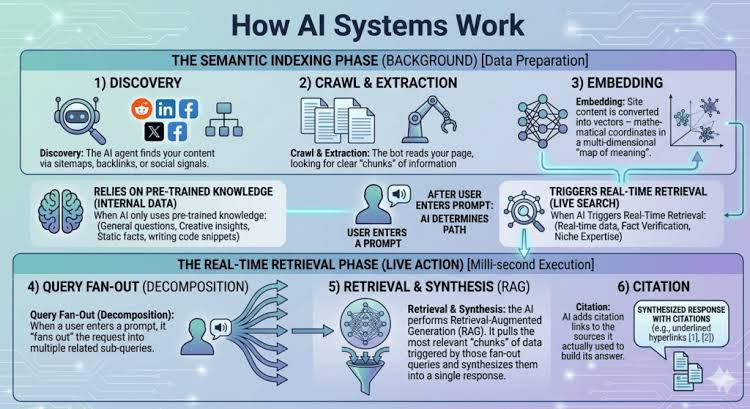
AI systems take semantic understanding even further. Large language models can analyze relationships between words, concepts, entities, and ideas to determine the broader meaning of content.
For example, an AI system can recognize that “Apple” could refer to a fruit or a technology company depending on the surrounding context.
AI can also identify whether content is
- Informational
- Transactional
- Navigational
- Comparative
- Educational
- Problem-solving
This contextual understanding helps AI deliver more relevant responses.
Why Semantic Relevance Matters for AI Search
As people increasingly use AI assistants to find information, content needs to be understandable within a broader context.
AI systems may consider relationships between the following:
Topics → Entities → Questions → Context → Intent → Answers
Content that clearly establishes these relationships can be easier for AI systems to interpret and connect with relevant queries.
Conclusion
Smart Semantic Relevance with AI combines semantic SEO principles with artificial intelligence to create more meaningful, context-rich content. By understanding topics, entities, search intent, and relationships between concepts, AI can help businesses develop content that is clearer, more comprehensive, and better aligned with modern search behavior.