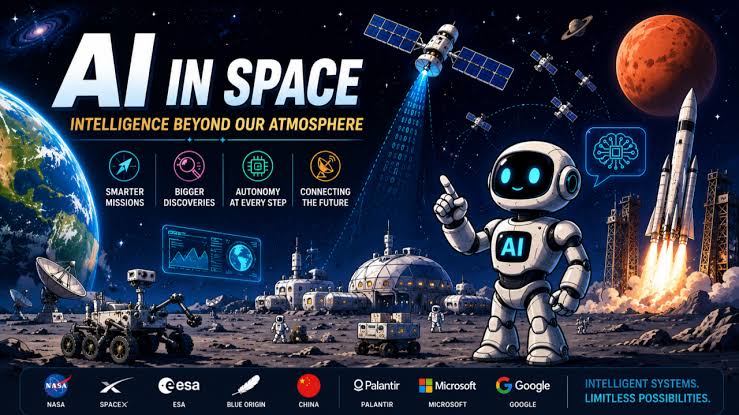
Artificial intelligence is transforming satellite technology from a system that mainly collects and transmits data into one that can increasingly analyze information, make decisions, optimize operations, and respond to changing conditions. This shift is creating a new generation of intelligent satellites for communications, Earth observation, weather forecasting, navigation, disaster response, and space exploration.
NASA and ESA are already demonstrating AI processing directly in orbit. NASA reported in 2026 that its Prithvi geospatial foundation model had been deployed on in-orbit platforms, while NASA’s Dynamic Targeting experiments have demonstrated onboard AI that can analyze imagery and help an Earth-observing spacecraft decide where to point its instruments.
What Is AI Satellite Technology?
AI satellite technology combines machine learning, computer vision, neural networks, edge computing, advanced sensors, and satellite communications. Traditional satellites generally collect information and send large amounts of raw data to Earth for processing. AI changes this model by allowing satellites to process some information before transmission.
For example, an AI-enabled satellite could examine thousands of images and determine which ones contain:
- Wildfires
- Flooding
- Ships
- Buildings
- Agricultural changes
- Cloud formations
- Environmental anomalies
- Other predefined targets
Instead of transmitting everything, the satellite can prioritize useful information. ESA’s Φsat-2 demonstrates this approach with onboard AI applications for cloud detection, vessel classification, image processing, wildfire detection, and marine anomaly detection.
Why AI Matters for Satellites
Satellites generate enormous amounts of data, but communication bandwidth, storage, energy, and processing resources are limited.
AI can help solve this problem through intelligent data filtering.
For example:
Satellite sensor → AI processing → Important information identified → Data prioritized → Ground station receives useful information
This can reduce unnecessary data transmission and potentially provide faster access to important information.
ESA’s earlier Φ-sat-1 mission demonstrated AI-based filtering of cloudy images so that unsuitable imagery did not need to be transmitted to Earth.
1. AI-Powered Earth Observation

Earth observation is one of the most important applications of AI in satellite technology.
AI can analyze satellite imagery to identify changes across large geographic areas. Applications include:
- Agriculture monitoring
- Forest monitoring
- Urban development
- Water management
- Environmental protection
- Infrastructure monitoring
- Disaster assessment
- Maritime surveillance
Instead of humans manually reviewing huge collections of satellite images, AI systems can identify patterns and highlight areas requiring attention. NASA’s Dynamic Targeting technology takes this idea further. During testing, onboard AI analyzed imagery and helped determine whether a satellite should capture a particular area, with the process taking less than 90 seconds without human intervention.
2. AI for Weather Forecasting
Satellite observations are essential for modern weather forecasting because satellites continuously provide information about clouds, storms, atmospheric conditions, and Earth’s surface. AI can combine satellite observations with historical weather information to improve prediction models. A recent example is Google’s Weather Next 3, which uses satellite and observational data in an AI-based forecasting system and aims to provide more frequent and higher-resolution predictions.
This could support:
- Storm prediction
- Flood warnings
- Agriculture planning
- Renewable-energy forecasting
- Aviation
- Emergency management
3. Smarter Disaster Response
AI-enabled satellites could become particularly valuable during natural disasters. After an earthquake, hurricane, wildfire, flood, or volcanic eruption, AI can rapidly examine satellite imagery to identify affected areas.
For example,
Fire → Location → Size → Direction of spread → Priority information
This can help emergency organizations receive actionable information faster.
ESA’s Φsat-2 includes AI capabilities designed for wildfire detection and marine anomaly detection, demonstrating how onboard processing can support time-sensitive environmental applications.
4. Autonomous Satellites
One of the biggest developments is the movement toward satellite autonomy.
Traditional spacecraft depend heavily on commands from ground operators. AI could allow future spacecraft to make certain operational decisions independently.
Possible applications include:
- Adjusting observation schedules
- Selecting targets
- Avoiding unnecessary imaging
- Optimizing power consumption
- Detecting equipment anomalies
- Managing onboard resources
- Coordinating satellite constellations
ESA has been exploring AI for making satellites more reactive, agile, and autonomous.
5. AI and Satellite Communications
AI isn’t limited to cameras and Earth observation. Telecommunications satellites can also benefit from machine learning for signal processing, interference detection, network optimization, and spectrum management. AI systems can potentially identify interference patterns and adjust communications strategies according to changing conditions. ESA has explored AI-based satellite telecommunications testbeds for interference classification and adaptive communications.
Meanwhile, the satellite-broadband industry continues to expand. In September 2026, the U.S. FCC proposed opening additional spectrum for space-based broadband services, highlighting the growing importance of satellite connectivity.
6. AI Foundation Models in Orbit
A major emerging trend is putting increasingly capable AI models directly into space. In May 2026, NASA announced that the Prithvi Geospatial AI foundation model had been successfully demonstrated on in-orbit platforms. The model was trained using 13 years of data and is designed for a range of Earth-observation tasks.
This represents an important change.
Instead of:
Satellite → Raw data → Earth → AI processing → Result
the future could increasingly look like:
Satellite → AI analysis in orbit → Important result → Earth
That could make satellite systems faster and more efficient.
7. Edge Computing in Space
AI satellites depend heavily on edge computing.
Edge computing means processing information close to where it is generated rather than sending everything to a distant data center.
In satellite systems, this means placing processors directly on spacecraft.
The benefits can include:
- Lower data-transmission requirements
- Faster analysis
- Reduced latency
- More efficient storage
- Faster responses to emergencies
- Greater satellite autonomy
ESA research has specifically examined radiation-tolerant AI-edge hardware for onboard Earth-observation processing.
8. AI Satellite Technology and Agriculture
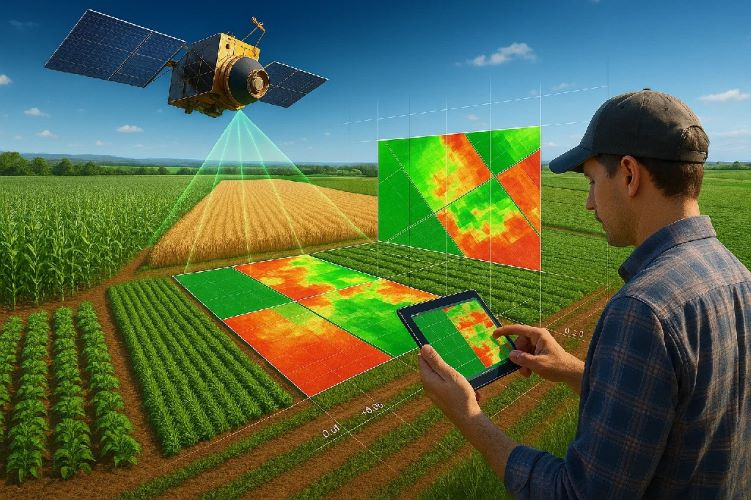
Agriculture could be another major beneficiary.
AI can analyze satellite imagery to identify:
- Crop stress
- Vegetation changes
- Water availability
- Irrigation problems
- Drought conditions
- Land-use changes
Farmers and agricultural organizations could use these insights to make decisions about irrigation, crop management, and resource allocation.
This creates an important connection between space technology, AI, and precision agriculture.
9. Environmental Monitoring
AI-enabled satellite systems can also support environmental protection.
Potential applications include:
- Deforestation detection
- Ocean monitoring
- Pollution detection
- Glacier monitoring
- Coastal changes
- Illegal fishing detection
- Water-quality analysis
- Climate research
ESA’s Φsat-2, for example, includes capabilities related to vessel detection and marine ecosystem anomalies.
10. AI Satellite Technology Challenges
Despite its potential, intelligent satellite technology faces significant challenges.
Limited Computing Power
Spacecraft have strict limitations on power, weight, cooling, and hardware capacity. AI processors must therefore deliver high performance without consuming excessive energy.
Radiation
Electronic components operating in space can be exposed to radiation. AI hardware must be designed and tested to operate reliably in this environment.
Data Quality
AI models depend on good training data. Poor-quality or biased datasets can produce unreliable results.
Cybersecurity
Connected satellites create cybersecurity risks. AI-enabled spacecraft may introduce additional attack surfaces that must be protected.
Model Reliability
A satellite making an autonomous decision cannot always wait for human intervention. AI models therefore need strong testing and safeguards.
Privacy and Security
High-resolution Earth observation can raise privacy, national-security, and ethical concerns. The growing combination of commercial satellites and AI has increased discussion around these risks.
The Future of AI and Satellite Technology
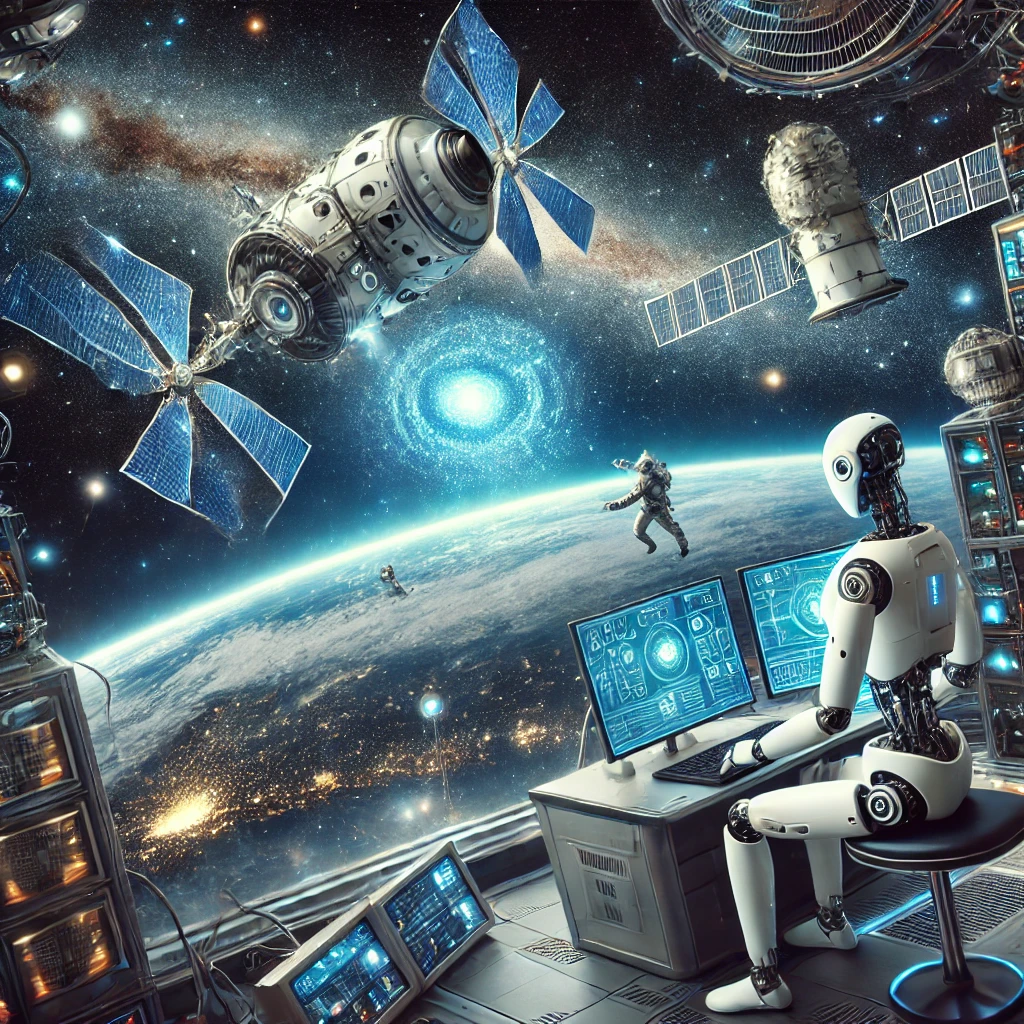
The next stage of satellite development will likely involve greater cooperation between AI, robotics, sensors, edge computing, cloud platforms, and satellite networks.
Future satellite systems could become increasingly capable of:
- Detecting events independently
- Choosing observation targets
- Sharing information with other satellites
- Optimizing communications
- Monitoring environmental changes
- Detecting anomalies
- Supporting disaster response
- Processing AI models directly in orbit
NASA and ESA’s current work suggests that this transition is already moving beyond theory and into practical demonstrations.
Benefits of AI-Powered Satellites
The major advantages include:
| Benefit | Impact |
| Faster processing | Information can be analyzed closer to the source |
| Lower bandwidth use | Unnecessary data can be filtered |
| Greater autonomy | Satellites can make selected decisions independently |
| Better Earth observation | Important events can be detected faster |
| Improved disaster response | Critical information can reach users sooner |
| Smarter communications | Networks can adapt to changing conditions |
Final Thoughts
AI and Satellite Technology The Next Frontier represents a major shift in how humanity uses space-based infrastructure. Satellites are evolving from passive data collectors into increasingly intelligent platforms capable of processing information, recognizing patterns, and supporting autonomous decisions. The combination of AI, onboard computing, advanced sensors, and satellite connectivity could make future space systems faster, more autonomous, and more useful on Earth. The most important development may not simply be launching more satellites—it may be making each satellite smarter. As NASA’s in-orbit AI experiments and ESA’s Φsat missions demonstrate, the era of AI-powered satellite technology is already beginning.