







What Is an AI-SBOM and Why Is It Different From an SBOM?
AI SBOM: Over the last decade, high-profile software supply chain attacks, such as SolarWinds, and critical vulnerabilities, including Log4j, have highlighted the need for greater software transparency and traceability. In response, governments and industry organizations have introduced initiatives and regulations designed to improve visibility into software components and dependencies. In the United States and European Union, for example, organizations are increasingly encouraged or required to track software components through Software Bills of Materials (SBOMs).
An SBOM provides a structured inventory of the software components and dependencies used within an application. This improves visibility into software development practices and helps organizations understand which third-party and open-source components are present in their applications. When SBOM information is combined with vulnerability databases and security advisories, organizations can identify affected components more quickly and take appropriate action.
However, a traditional SBOM may not provide sufficient visibility into the unique components of an AI system. AI applications can depend on training datasets, pre-trained models, model weights, prompts, configurations, evaluation data, and other AI-specific artifacts that may not appear in a conventional SBOM. Without this information, organizations may overlook risks associated with the AI components that influence model behavior.
Why Is an AI-SBOM Different From an SBOM?
An AI Software Bill of Materials (AI-SBOM) extends the concept of an SBOM to address the unique characteristics and risks of AI/ML systems. While an SBOM primarily focuses on software packages, libraries, and dependencies, an AI-SBOM can provide visibility into both traditional software components and AI-specific elements involved throughout the AI lifecycle.
These elements can include:
- Training and validation datasets
- Pre-trained models and model versions
- Model weights and artifacts
- AI/ML frameworks and libraries
- APIs and third-party AI services
- Model configurations and parameters
- Data processing components
- Development and deployment environments
- AI agents and supporting tools
This broader view is important because vulnerabilities can exist not only in software dependencies but also in data, models, configurations, and other AI components. For example, compromised training data or tampered model weights could affect model behavior even when the underlying software is free from known vulnerabilities.
Recognizing these gaps, government agencies and industry organizations have developed frameworks and guidance addressing AI-specific security risks. Initiatives such as MITRE ATLAS and NIST guidance for secure development of generative AI and dual-use foundation models emphasize the importance of documenting and protecting AI development processes.
AI-SBOMs have, therefore, emerged as a complementary approach to traditional SBOMs. Like SBOMs, they can provide structured, machine-readable records of components and dependencies while extending visibility to AI-specific artifacts and processes.
When AI-SBOMs are properly signed, versioned, and maintained, they can also support stronger integrity and traceability. Organizations can use them to establish a verifiable record of the components and processes involved in developing and deploying an AI system.
Importantly, this visibility can extend to components hidden behind APIs or abstracted by cloud service providers. By documenting these dependencies where possible, AI-SBOMs can help organizations better understand what their AI systems rely on, identify potential risks, and establish greater confidence in the integrity of AI model inputs and processes.
In short, an SBOM helps answer “What software is inside this application?” while an AI-SBOM expands that question to “What software, data, models, and other components make this AI system work?” This broader perspective makes AI-SBOMs an important tool for managing the increasingly complex AI supply chain.
Improving AI Supply Chain Visibility
Organizations such as Microsoft Research, Microsoft AI Red Team (AIRT), MITRE ATLAS, and OWASP have documented numerous security threats affecting AI systems. These include compromised dependency chains, impersonation of model publishers, backdoors in AI models, and prompt injection attacks that can compromise AI applications.
These threats highlight a fundamental challenge: organizations may not have sufficient visibility into the components used to build and operate their AI systems. An AI-SBOM helps address this gap by providing a structured inventory of AI-specific and traditional software components, making it easier to understand what an AI system depends on and verify the integrity of those components.
What Information Does an AI-SBOM Capture?
Building on the concept of a traditional SBOM, an AI-SBOM can capture AI- and dataset-specific metadata that is particularly important for security, traceability, and governance. This may include:
- Dataset provenance and lineage — Information about where datasets originated, how they were processed, and how they moved through the AI development lifecycle.
- Model identity and architecture — Details about the model, its architecture, version, hyperparameters, and applicable licensing information.
- AI libraries and frameworks — Software frameworks, libraries, and tools used to train models, process data, and support deployment.
- Security artifacts — Hashes, checksums, signatures, and other integrity information that can help detect unauthorized modifications or tampering.
These metadata elements can help organizations identify suspicious changes, investigate vulnerabilities, and understand the dependencies that may affect an AI system’s security.
Supporting Risk Management and Incident Response
An AI-SBOM can also serve as a forensic record of an AI system’s components and development history. During a security incident, this information can help teams determine which models, datasets, dependencies, or other components may have been affected.
For compliance teams, AI-SBOMs can support audits and regulatory reporting by providing documented evidence of the components and processes associated with an AI system. Security teams can also use this information to assess vulnerabilities and prioritize remediation.
As governments, regulators, and standards organizations continue developing expectations for AI security, transparency, and assurance, AI-SBOMs are likely to become an increasingly important foundation for AI supply chain security, risk management, and trustworthy AI governance.
When and Where in the ML Pipeline Lifecycle Should AI-SBOMs Be Generated and Scanned?
AI/ML model development has its own lifecycle, much like the traditional Software Development Life Cycle (SDLC). It spans stages such as design, data preparation, model development, training, validation, deployment, monitoring, and ongoing improvement. Each stage introduces or modifies artifacts—including datasets, model weights, source code, dependencies, and configurations—that can influence a model’s behavior, quality, and security.
Because these artifacts evolve throughout the AI/ML lifecycle, AI-SBOM generation should not be treated as a one-time event. Instead, AI-SBOMs should be generated and scanned at multiple stages to maintain continuous visibility into model lineage, dependencies, and security posture.
AI-SBOM Generation Throughout the ML Lifecycle
The Joint Guidance: A Shared Vision of Software Bill of Materials, published by CISA and endorsed by government agencies around the world, recognizes that SBOMs can and should be generated at multiple points throughout the software lifecycle. The guidance encourages automated scanning to identify components during development and automated analysis of existing software, whether in source or binary form.
The same principle can be applied to AI-SBOMs. Generating and scanning AI-SBOMs throughout the AI/ML lifecycle allows organizations to identify changes, track dependencies, and maintain a more complete record of how an AI system evolves.
1. Design and Planning
AI-SBOM generation can begin during the design phase, before model development starts. At this stage, organizations can document planned models, datasets, AI frameworks, APIs, third-party services, and other dependencies.
Creating an early AI-SBOM establishes a baseline against which future changes can be compared and helps teams identify potential supply chain risks before development progresses.
2. Development and Data Preparation
During development, new libraries, frameworks, datasets, scripts, and development tools are introduced. AI-SBOMs should be updated to reflect these components and their relationships
Scanning at this stage can help identify vulnerable dependencies, untrusted sources, licensing concerns, and unexpected components before they become embedded in the AI system.
3. Training and Model Creation
The training stage introduces important AI-specific artifacts, including training datasets, preprocessing pipelines, model configurations, checkpoints, and model weights.
Generating an AI-SBOM at this point provides a record of the inputs and components used to create a specific model version. Scanning can also help identify unauthorized modifications, suspicious artifacts, or known vulnerabilities in the supporting software environment.
4. Validation and Testing
Before deployment, AI systems undergo validation and testing. Changes to datasets, model weights, configurations, or dependencies can occur during this stage.
An updated AI-SBOM provides a snapshot of the components used in the tested model. Comparing it with previous versions can help teams identify unexpected changes and verify that the model being evaluated matches the intended build.
5. Deployment
Deployment can introduce additional infrastructure, APIs, cloud services, containers, runtime libraries, and configuration settings. An AI-SBOM generated at deployment captures these components and establishes a record of what is actually being released.
Scanning at this stage provides an additional security checkpoint before the AI system enters production.
6. Runtime and Monitoring
AI-SBOM management should continue after deployment. Production environments can change as models are updated, dependencies are patched, datasets are refreshed, and infrastructure evolves.
Regularly updating and scanning AI-SBOMs helps organizations maintain an accurate view of the production environment and identify newly discovered vulnerabilities or unexpected component changes.
7. Model Updates and Retirement
AI systems are rarely static. Models may be retrained with new datasets, fine-tuned, replaced, or updated with new dependencies. Each significant change should trigger an AI-SBOM update and appropriate security scanning.
Maintaining historical AI-SBO MS also creates a useful record of model lineage and component changes, supporting future audits, investigations, and incident response.
Why Continuous AI-SBOM Generation Matters
CISA guidance on SBOMs recognizes that different SBOM types can provide information about software at different stages, including design, source, build, and deployment. Each representation provides a different perspective and can serve different use cases. An SBOM therefore should not be viewed as a static document created once and forgotten.
The same approach is particularly important for AI/ML systems because their components can change rapidly. A model’s security posture may change when its training data, model weights, dependencies, configurations, or runtime environment changes.
The NTIA’s Minimum Elements for SBOMs also emphasize keeping SBOM information current when components change. Applying this principle to AI-SBOMs means organizations should generate, update, and scan AI-SBOMs throughout the ML pipeline rather than relying on a single snapshot.
Ultimately, continuous AI-SBOM generation creates a more complete and trustworthy record of an AI system’s evolution—from initial design and data preparation through training, deployment, monitoring, and eventual retirement. This helps organizations maintain visibility, detect risks earlier, support incident response, and strengthen AI supply chain security.
Challenges in Operationalizing AI-SBOMs
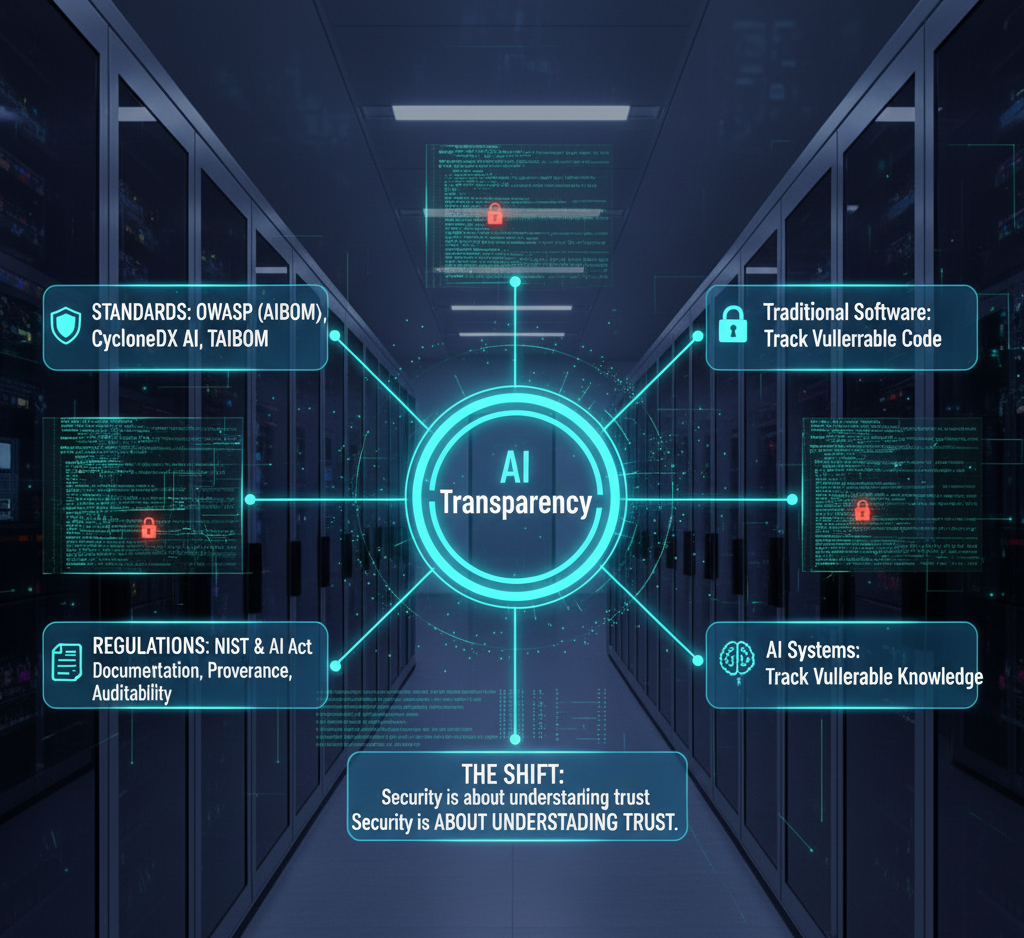
AI-SBOMs offer significant benefits for strengthening trust in the AI supply chain (AI SC) and improving risk management. By providing greater visibility into AI models, datasets, dependencies, and development processes, they can support security, transparency, reproducibility, incident response, and regulatory compliance.
However, operationalizing AI-SBOMs at scale presents several challenges. Organizations must overcome technical, governance, data, and regulatory obstacles to create AI-SBOMs that are both comprehensive and useful.
Immature Automation and Tooling
One of the biggest challenges is the relative immaturity of automated tools for generating and maintaining AI-SBOMs. Traditional software environments have established methods for identifying libraries and dependencies, but AI/ML systems contain additional artifacts such as datasets, model weights, training configurations, evaluation results, and model-specific metadata.
Capturing this information consistently across every stage of the AI/ML lifecycle can be difficult. Organizations may need tools that integrate with development environments, data pipelines, model registries, CI/CD systems, and cloud platforms to create an accurate and continuously updated AI-SBOM.
Limited Access to Model and Data Information
Organizations may not always have access to the information needed to create a comprehensive AI-SBOM. Closed-source models, proprietary AI services, third-party APIs, and cloud-based platforms can hide important details about model architecture, training data, dependencies, or development processes.
This creates a visibility gap. An organization may know which API or model it uses without knowing all of the underlying components that contribute to its behavior or security posture.
Inconsistent Data Governance
AI-SBOMs depend heavily on reliable metadata, but organizations often have inconsistent data governance practices. Information about datasets, model versions, dependencies, and ownership may be stored across different systems or maintained by different teams.
Without standardized processes for collecting and maintaining this information, AI-SBOMs can become incomplete, outdated, or difficult to verify.
Data Privacy and Confidentiality
AI-SBOMs can contain sensitive information about datasets, models, and development environments. Organizations therefore need to balance transparency with privacy, confidentiality, intellectual property protection, and security.
For example, documenting dataset lineage may improve traceability while simultaneously exposing sensitive information about the data or its sources. Organizations must determine what information can safely be included in an AI-SBOM and who should have access to it.
Determining the Right Metadata
Not every organization needs the same AI-SBOM information. Security teams may prioritize vulnerabilities and software dependencies, while compliance teams may focus on provenance, licensing, and regulatory requirements. Data science teams may need information about datasets, model versions, and training processes.
As a result, organizations must determine which metadata is relevant to each use case without creating unnecessary complexity or excessive documentation requirements.
Evolving Standards and Requirements
AI technologies, security threats, regulations, and industry standards continue to evolve. A fixed AI-SBOM framework may quickly become outdated as new model architectures, development practices, vulnerabilities, and regulatory expectations emerge.
Organizations therefore need adaptable approaches that can evolve alongside the AI landscape. AI-SBOM processes should be designed to accommodate new metadata requirements, emerging threats, changing compliance obligations, and advances in AI development practices.
Building a Practical AI-SBOM Strategy
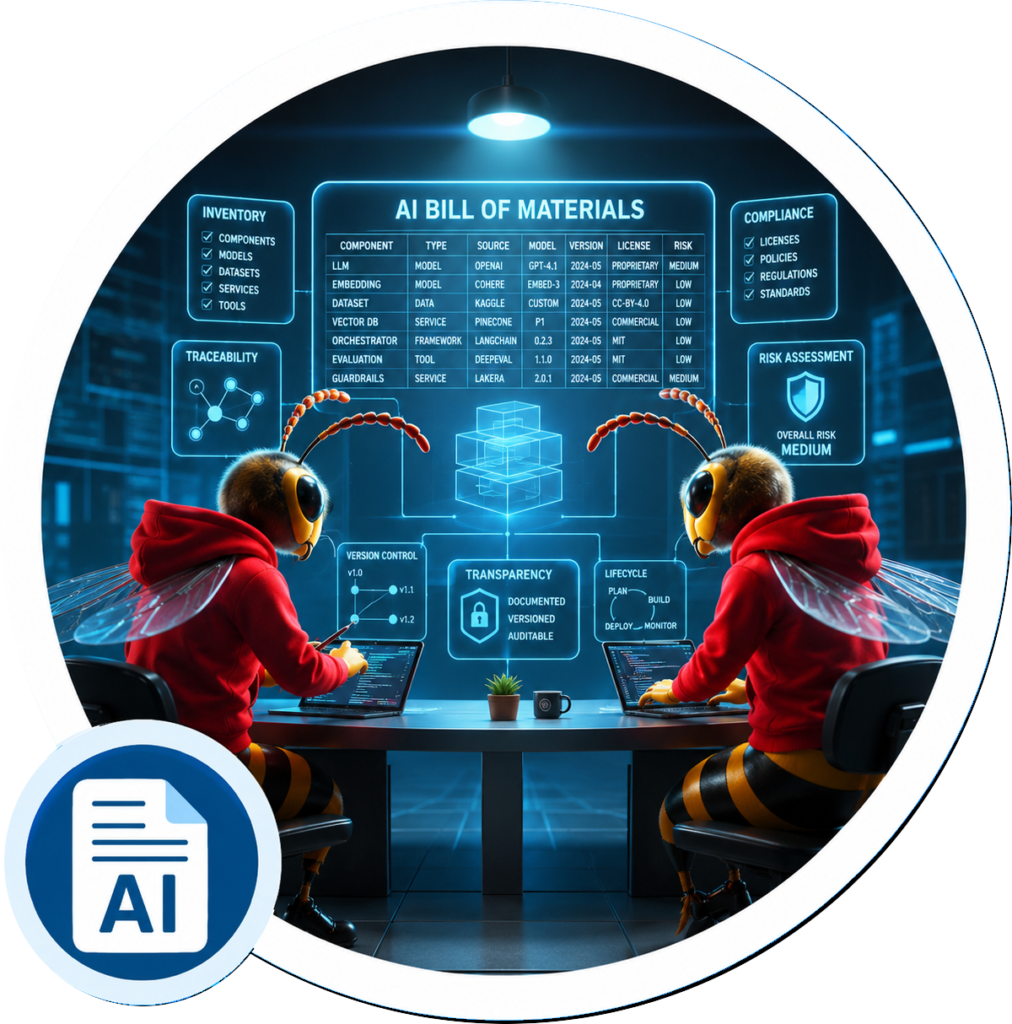
Operationalizing AI-SBOMs requires more than simply generating an inventory of AI components. Organizations need a coordinated approach that combines automation, governance, access controls, standardized metadata, and continuous updating.
By addressing these challenges, organizations can develop AI-SBOM practices that provide meaningful visibility without creating unnecessary operational burdens. The ultimate goal is to make AI-SBOMs practical, scalable, and useful for improving AI supply chain security, transparency, reproducibility, risk management, and compliance.
Conclusion
As AI/ML models become increasingly integrated into traditional software supply chains, they introduce new and evolving security risks. This changing landscape has led to the emergence of the AI supply chain (AI SC) and increased the need for organizations to understand, document, and track the components that influence AI systems.
Traditional Software Bills of Materials (SBOMs) provide valuable visibility into software dependencies and components, but they may not capture critical AI-specific elements such as training datasets, model weights, model configurations, and AI/ML frameworks. AI-SBOMs extend the scope of traditional SBOMs to address these gaps, providing greater traceability, transparency, and visibility into the components and processes that shape AI/ML models.
However, adopting AI-SBOMs at scale is not without challenges. Immature tooling, incomplete or inaccurate metadata, limited access to proprietary model information, privacy concerns, and uncertainty about which information is most relevant to different use cases can all hinder effective implementation.
To realize the full value of AI-SBOMs, organizations should adopt a lifecycle-based approach that supports continuous visibility from design and data preparation through training, deployment, monitoring, and model updates. They should also clearly define their use cases, establish strong data governance and cataloging practices, and develop processes for generating accurate and meaningful AI-SBOMs.
Organizations should also be prepared to share AI-SBOM information across ecosystems where partners, customers, regulators, and service providers may have different requirements and expectations. Doing so can strengthen an organization’s own security posture while contributing to greater transparency and trust throughout the broader AI ecosystem.
Ultimately, successful AI-SBOM adoption will require continued collaboration among government, industry, standards organizations, and researchers. By improving standards, tooling, governance practices, and interoperability, stakeholders can make AI-SBOMs more practical and actionable—and help build a more secure, transparent, and resilient AI Supply Chain.