





What Is Multi-Agent Collaboration?
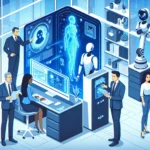
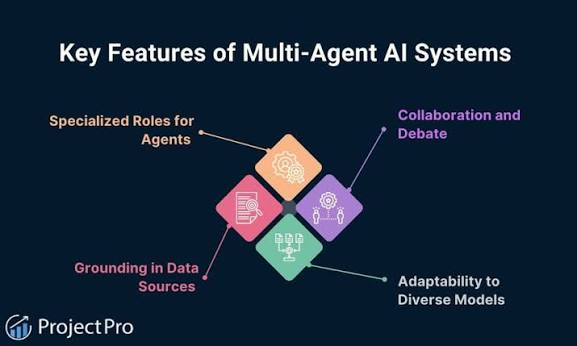
Multi-agent collaboration is an AI approach in which multiple specialized AI agents work together to complete a complex task. Instead of relying on one AI agent to handle everything, each agent can have a specific role, responsibility, toolset, or area of expertise.
For example, a business research system might use:
- Research Agent – gathers information
- Analysis Agent – examines and interprets the information
- Writing Agent – creates the final content
- Fact-Checking Agent – verifies important claims
- Manager Agent – coordinates the other agents
Together, these agents can solve problems that may be difficult for a single agent to handle efficiently.
How Multi-Agent Collaboration Works
A typical multi-agent system follows several stages:
1. Task Planning
A primary or orchestrator agent receives the user’s request and divides it into smaller tasks.
For example:
“Create a market analysis for an AI software company.”
The system might divide this into:
- Research competitors
- Analyze market trends
- Identify customers
- Examine pricing
- Assess risks
- Prepare the report
2. Task Assignment
The orchestrator assigns each task to an appropriate specialized agent.
Each agent may have different:
- Instructions
- Tools
- Data sources
- Knowledge
- Permissions
- Objectives
3. Independent Work
Agents perform their assigned tasks, sometimes simultaneously.
For example, the competitor-research agent can work while another agent investigates market trends.
4. Information Sharing
Agents exchange results through a shared workspace, messages, databases, APIs, or structured outputs.
One agent’s findings can become another agent’s input.
5. Review and Verification
A separate agent can check the work for:
- Accuracy
- Missing information
- Contradictions
- Formatting
- Compliance
- Quality
6. Final Synthesis
The orchestrator or another synthesis agent combines the individual outputs into one final result.
Common Multi-Agent Architecture
A simple architecture looks like this:
User → Orchestrator → Specialized Agents → Review Agent → Final Answer
For example:
User
↓
Orchestrator
┌───────────┼───────────┐
↓ ↓ ↓
Research Analysis Data Agent
Agent Agent
↓ ↓ ↓
└───────────┼───────────┘
↓
Review Agent
↓
Final Output
Types of Multi-Agent Collaboration
1. Hierarchical Collaboration
One manager agent coordinates several worker agents.
Manager Agent
├── Research Agent
├── Coding Agent
├── Data Agent
└── Review Agent
This is useful when a task has many clearly defined components.
2. Peer-to-Peer Collaboration
Agents communicate directly with each other without a single permanent manager.
For example:
Agent A ↔ Agent B
↕ ↕
Agent C ↔ Agent D
This can work well when agents need to exchange information dynamically.
3. Sequential Collaboration
Agents complete tasks one after another.
Research → Analysis → Writing → Review
Each agent receives the previous agent’s output.
4. Parallel Collaboration
Several agents work simultaneously.
┌→ Agent A
Task → Router ├→ Agent B
└→ Agent C
This can reduce processing time for independent tasks.
5. Debate-Based Collaboration
Multiple agents independently analyze a problem and challenge each other’s conclusions.
For example:
- Agent A proposes an answer.
- Agent B looks for weaknesses.
- Agent C provides an alternative analysis.
- A judge agent evaluates the evidence.
This approach can be useful for complex reasoning and quality control.
Key Components
Orchestrator
The orchestrator manages the overall workflow.
Its responsibilities can include:
- Breaking down tasks
- Selecting agents
- Assigning work
- Monitoring progress
- Handling failures
- Combining results
Specialized Agents
Each agent focuses on a particular responsibility.
Examples include:
- Research agent
- Coding agent
- Customer-support agent
- Sales agent
- Marketing agent
- Data analysis agent
- Security agent
- Legal-document review agent
- Financial analysis agent
Communication Layer
Agents need a way to exchange information.
Communication can occur through:
- Messages
- APIs
- Shared databases
- Queues
- Files
- Shared memory
- Structured JSON outputs
Shared Memory
Shared memory allows agents to access information produced by other agents.
For example:
Research Agent
↓
Market Data
↓
Analysis Agent
↓
Market Insights
↓
Writing Agent
Tools
Agents can use external tools such as
- Web search
- Databases
- CRM systems
- Spreadsheets
- APIs
- Code execution
- Document systems
- Business applications
Example: Multi-Agent Customer Service System
A company could create a customer-service system containing several agents.
Customer Agent
Receives the customer’s question.
Classification Agent
Determines whether the request concerns:
- Billing
- Technical support
- Returns
- Account management
Specialist Agent
Handles the relevant problem.
Knowledge Agent
Retrieves information from company documentation.
Escalation Agent
Determines whether a human employee should become involved.
Summary Agent
Creates a concise record of the interaction.
This allows the system to handle different types of customer requests without forcing one AI agent to perform every task.
Multi-Agent Collaboration in Software Development
Multi-agent systems can also support software development.
For example:
Project Manager Agent
↓
Requirements Agent
↓
Architect Agent
↓
Coding Agent
↓
Testing Agent
↓
Security Agent
↓
Documentation Agent
The coding agent can create software while testing and security agents independently inspect the implementation.
This can help automate portions of:
- Requirements analysis
- Architecture
- Coding
- Testing
- Debugging
- Documentation
- Code review
Human developers can remain involved in important decisions and approvals.
Benefits of Multi-Agent Collaboration
1. Specialization
Agents can be optimized for different tasks instead of trying to make one agent excellent at everything.
2. Parallel Processing
Independent tasks can be performed simultaneously, potentially improving workflow speed.
3. Scalability
Organizations can add new specialized agents when new requirements appear.
4. Better Task Decomposition
Complex problems can be divided into smaller, manageable components.
5. Quality Checking
One agent can review another agent’s work, providing an additional layer of verification.
6. Tool Specialization
Different agents can have access to different tools and data sources.
7. Automation
Multi-agent systems can automate workflows involving multiple steps and applications.
Challenges of Multi-Agent Collaboration
Multi-agent systems also introduce significant challenges.
Coordination
Agents need clear instructions about who is responsible for each task.
Communication Overhead
Agents exchanging many messages can increase latency and computing costs.
Conflicting Results
Two agents may reach different conclusions.
A system therefore needs mechanisms for resolving disagreements.
Error Propagation
An incorrect output from one agent can become the input for several other agents.
Security
Agents with access to business systems may create security and permission risks.
Cost
Running multiple agents can require substantially more computation than running one agent.
Complexity
Debugging a multi-agent workflow can be harder because problems may originate from interactions between agents rather than from one agent alone.
Multi-Agent Collaboration vs. Single AI Agent
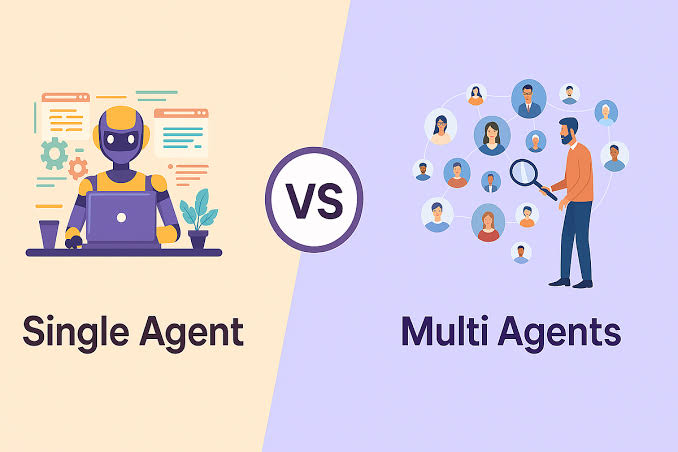
| Feature | Single Agent | Multi-Agent System |
| Task handling | Centralized | Distributed |
| Specialization | Limited | High |
| Parallel work | Limited | Strong |
| Coordination | Simple | More complex |
| Cost | Usually lower | Can be higher |
| Debugging | Easier | More difficult |
| Scalability | Moderate | Potentially high |
| Quality control | Usually internal | Can use independent reviewers |
Real-World Applications
Multi-agent collaboration can be applied to many industries.
Healthcare
Agents can support:
- Medical-document processing
- Research analysis
- Administrative workflows
- Patient communication
- Clinical data organization
Human professionals should remain responsible for appropriate clinical decisions.
Finance
Possible applications include:
- Financial research
- Risk analysis
- Document processing
- Fraud monitoring
- Reporting
Marketing
Agents can collaborate on:
- Keyword research
- Competitor analysis
- Content creation
- Social media planning
- Campaign analysis
E-Commerce
Agents can manage:
- Product research
- Customer questions
- Inventory analysis
- Recommendation workflows
- Order support
Cybersecurity
Different agents can monitor:
- Network activity
- Security logs
- Threat intelligence
- Vulnerabilities
- Incident reports
Business Operations
Agents can coordinate:
- Sales
- Customer service
- Finance
- HR
- Procurement
- Reporting
Multi-Agent Collaboration and AI Agents
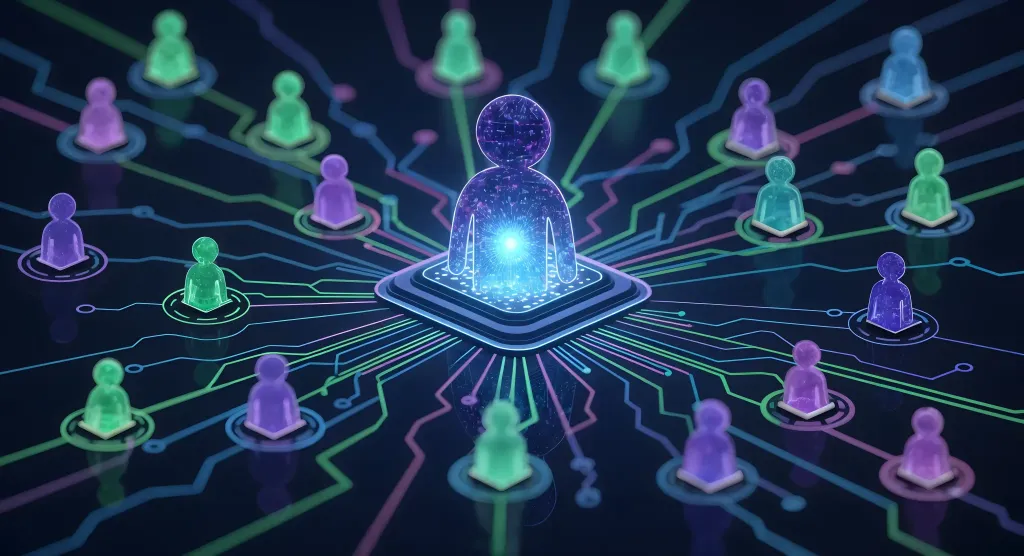
The key difference is that an AI agent can perform tasks autonomously, while multi-agent collaboration connects multiple agents into a coordinated system.
A useful way to think about it is:
AI agent = individual worker
Multi-agent system = team of specialized workers
Orchestrator = manager or coordinator
Shared tools/data = workplace
Best Practices
For organizations developing multi-agent systems, several principles are important:
- Give every agent a clearly defined role.
- Avoid unnecessary agents.
- Use structured communication between agents.
- Keep permissions limited to what each agent needs.
- Validate important outputs.
- Create human approval points for high-impact decisions.
- Monitor costs and latency.
- Log agent actions for auditing and debugging.
- Design clear failure and escalation procedures.
- Measure the system against the original business objective.
Conclusion
Multi-agent collaboration is an AI architecture in which multiple specialized agents communicate, coordinate, and work together toward a shared objective. It can make complex workflows more modular by dividing responsibilities among research, analysis, execution, verification, and coordination agents.
Its main advantages are specialization, parallel processing, automation, scalability, and independent quality checking. However, organizations must also manage communication overhead, cost, security, conflicting outputs, and error propagation. For many business applications, the most practical design combines autonomous agents with clear permissions, verification steps, monitoring, and human oversight.