






AI ML Jargon Decoded in 2026 means explaining the most common Artificial Intelligence AI and Machine Learning ML terms in simple language, so beginners can understand how modern AI systems work.
Key AI ML jargon in 2026
- AI Artificial Intelligence: Technology that enables computers to perform tasks that normally require human intelligence.
- Machine Learning ML: A branch of AI where systems learn patterns from data instead of being explicitly programmed for every task.
- Generative AI: AI that creates new text, images, audio, video or code.
- LLM Large Language Model: An AI model trained on large amounts of text to understand and generate language.
- Multimodal AI: AI that can work with multiple types of information, such as text, images, audio and video.
- Prompt: Instructions or questions given to an AI model.
- Fine tuning: Further training a model on specialized data to improve its performance for a particular task.
- RAG Retrieval-Augmented Generation: A technique that lets an AI retrieve relevant information before generating an answer.
- AI Agent: An AI system capable of planning and taking actions to accomplish a goal.
- Inference: The process of using a trained AI model to produce an output.
- Hallucination: When an AI produces information that sounds convincing but is incorrect or unsupported.
- AI Guardrails: Rules and technical controls designed to make AI systems safer and more reliable.
- Neural Network: A machine learning architecture inspired loosely by the way biological brains process information.
- Token: A small unit of text that an AI language model processes.
- Context Window: The amount of information an AI model can consider at once.
In simple terms:
AI ML Jargon Decoded in 2026 is a beginner friendly guide to understanding the vocabulary behind todays AI technologies without needing advanced technical knowledge.
Details of AI ML Jargon Decoded in 2026
A beginner s guide to the technical words used in machine learning ML and artificial intelligence AI is AI ML Jargon Decoded in 2026. The intention is to simplify difficult ideas without requiring a background in computer science or programming.
AI and ML: What Are They?
The more general field of developing computer systems that can carry out activities related to human intellect, like comprehending language, identifying images, making predictions and producing content is known as artificial intelligence AI.
A key component of AI is machine learning ML. Machine learning ML systems discover patterns from data and utilize those patterns to generate predictions or judgments rather than explicitly programming every rule.
Common Terms for AI and ML
1. Algorithm
An algorithm is a collection of commands or mathematical procedures that a computer uses to process data or solve problems.
2. Dataset An
AI or ML systems can be trained, tested or assessed using a dataset.
3. Model
A model is a trained system that can generate predictions, classifications or other outputs by using patterns it has learned from data.
4. Instruction
An ML model learns from examples in a dataset during the training process.
5. Conclusion
When a trained model applies its knowledge to produce a response, prediction, classification or other outcome from fresh input. This is known as inference.
6. The Neural Network
An ML architecture composed of linked compute units that can extract intricate patterns from data is called a neural network.
7. Deep Learning
Deep learning learns progressively sophisticated data representations by using multi layered neural networks.
8. Artificial Intelligence
AI systems that can produce fresh text, images, audio, video or code are referred to as generative AI.
9. The LLM, or large language model
An LLM is a model that can process and produce human like language after being trained on vast volumes of text.
10. Quick
An AI system’s instructions or information that directs its reaction is called a prompt.
11. A token
A token is a text unit that a language model processes. A token can be a word. A portion of a word, punctuation or another text segment depending on the system.
12. Natural Language

Processing NLP is the branch of artificial intelligence that focuses on making it possible for computers to comprehend, process and produce human language.
13. Vision in computers
AI systems can evaluate and understand visual data including images and videos. Thanks to computer vision.
14. Guided Education
A model learns from training examples that contain labels or known responses in supervised learning.
15. Unsupervised Education
Algorithms find patterns or structures in data without predetermined labels in unsupervised learning.
16. Learning via Reinforcement
An agent is trained through interactions with its surroundings using reinforcement learning. which uses incentives or punishments to promote better choices.
The Significance of AI ML Jargon in 2026
Comprehending basic terms facilitates: Keep up with AI technology news.
Select AI resources. Recognize machine learning initiatives. Interact with data scientists and developers. Study sophisticated AI concepts. Assess AI products more efficiently. Recognize the operation of generative AI.
Basic AI ML Example
Let’s say you want an AI system to identify cats in pictures.
Data → Model → Training → New Image → Forecast
During training a large number of labeled photos are sent to the system. The machine learning model picks up cat-related visual patterns. The trained model can determine whether a cat is present in a given fresh image.
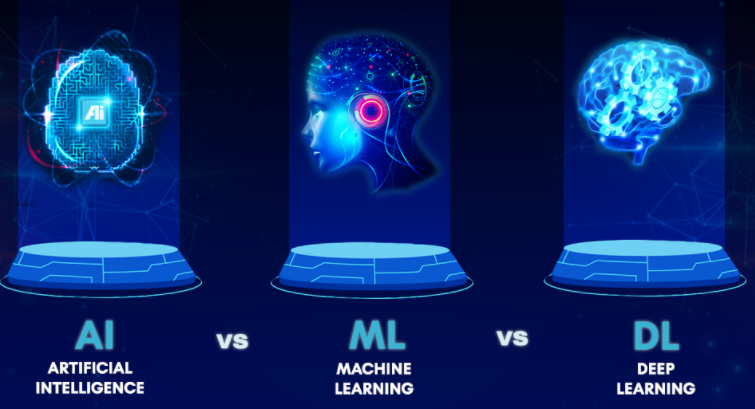
AI vs ML and Deep Learning
| Terms | Simple meaning |
| AI | The extensive area of intelligent computer systems |
| MI | Systems that use data to identify patterns |
| Deep Learning | ML using multi-layer neural networks |
| Generative AI | AI that produces original content |
| LLM | model with a focus on language |
First Takeaway
The most crucial assumption is that deep learning is a potent ML technique. AI is a broad concept and ML is a major approach inside AI. Terms like datasets, models, training, inference, neural networks, prompts, tokens, NLP and generative AI become much simpler to comprehend once these foundations are established.
In conclusion,
AI ML Jargon Decoded in 2026 provides novices with a useful basis for delving into the quickly developing field of AI by simplifying complex technical terms.