Introduction
AI infrastructure news focuses on the latest developments in the hardware, software, cloud platforms, data centers, networking systems, and energy resources that make artificial intelligence possible. As businesses increasingly adopt generative AI, AI agents, machine learning, and automation, demand for reliable and powerful AI infrastructure continues to grow.
AI infrastructure is the foundation that allows organizations to train AI models, process large datasets, run AI applications, and deliver intelligent services at scale. Companies are investing in specialized processors, high-performance computing, cloud infrastructure, and energy-efficient data centers to support the next generation of AI technology.
Latest AI Infrastructure News in 2026
As of October 14, 2026, several major developments are shaping the AI infrastructure industry.
1. Europe expands AI supercomputing capacity.
French cloud provider Scaleway announced plans for an AMD-powered AI supercomputer in Sweden. The system is designed to provide computing capacity to European startups, AI companies, and businesses, expanding alternatives to Nvidia-based systems.
2. New Nvidia-powered computing site in Copenhagen
Scaleway also announced a Copenhagen computing site using Nvidia’s HGX B300 system. The expansion targets European organizations seeking advanced AI computing hosted under European Union rules.
3. AWS and Nvidia expand AI infrastructure.
Amazon Web Services and Nvidia announced plans to deploy an additional two million Nvidia GPUs across AWS infrastructure during 2027–2028. The collaboration also covers networking, AI factories, enterprise automation, robotics, and government computing.
4. AI electricity demand drives grid investment.
Growing demand from data centers is putting pressure on electricity transmission networks. Reuters reported that PJM, a major US grid operator, proposed $12.2 billion in improvements to address reliability and related infrastructure needs.
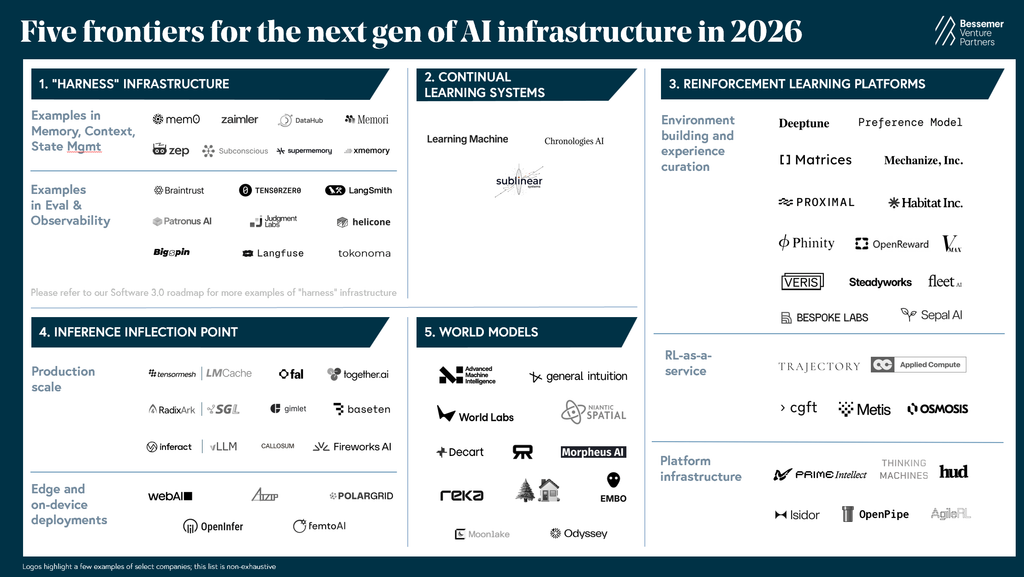
5. AI chip networking becomes a bigger priority.
Nvidia-backed startup Upscale AI launched Token Fabric, a platform intended to connect AI chips from different suppliers within data centers. Its goal is to simplify mixed-hardware deployments.
What Is AI Infrastructure?

AI infrastructure is the complete technology environment used to develop, train, deploy, and operate artificial intelligence systems. It combines physical equipment, computing resources, software platforms, data storage, networking, security, and energy management.
The main components include:
- AI chips and GPUs: Perform the large-scale mathematical calculations required by AI models.
- AI data centers: House servers, processors, networking equipment, power systems, and cooling infrastructure.
- Cloud computing: Provides computing resources that businesses can rent instead of building their own facilities.
- Data storage: Stores training datasets, business records, model parameters, and application data.
- Networking: Connects processors and servers so they can exchange information quickly.
- AI software platforms: Support model training, deployment, monitoring, and application development.
- Security infrastructure: Protects sensitive data, models, access credentials, and computing environments.
- Power and cooling: Keep high-performance computing systems operating reliably.
Major Companies in AI Infrastructure
The industry includes semiconductor manufacturers, cloud providers, networking companies, and data center operators.
| Company | Main area of AI infrastructure |
| NVIDIA | GPUs, AI computing platforms, networking |
| AMD | CPUs, GPUs, data center accelerators |
| Amazon Web Services | Cloud infrastructure, GPU computing, AI services |
| Google Cloud | AI cloud services, custom TPU processors, data centers |
| Microsoft Azure | Cloud computing, enterprise AI, AI infrastructure |
| Intel | CPUs and data center computing |
| Broadcom | Networking silicon and custom chips |
| Oracle Cloud Infrastructure | Cloud infrastructure and AI computing |
These companies have different roles, and their offerings vary by workload, availability, region, and pricing.
Benefits of AI Infrastructure for Businesses
Well-designed AI infrastructure can help organizations:
- Improve productivity: Run AI-powered workflows and automate repetitive tasks.
- Scale operations: Increase computing capacity as demand grows.
- Analyze data faster: Process large datasets for reporting and decision-making.
- Develop AI products: Build chatbots, recommendation engines, document-processing systems, and AI agents.
- Improve customer experiences: Support personalized services and faster responses.
- Strengthen security: Apply access controls, encryption, monitoring, and governance.
- Control costs: Match computing capacity to demand and select suitable cloud or on-premises systems.
Future of AI Infrastructure

The future of AI infrastructure will likely involve more specialized processors, interconnected computing systems, more efficient cooling, distributed AI services, and better coordination between data centers and power grids.
Three developments deserve particular attention:
- AI factories: Integrated computing environments designed to turn data and electricity into AI outputs at scale.
- Distributed AI computing: AI workloads running across cloud data centers, telecommuter networks, and edge devices.
- Flexible energy management: Systems that adjust non-urgent computing workloads to help manage grid constraints without compromising critical services.
Conclusion
AI infrastructure news in 2026 highlights a major shift in how computing resources are developed and delivered. GPU expansion, European AI supercomputers, advanced networking, cloud partnerships, and growing electricity demand are all influencing the industry’s direction.
The next stage of AI growth will depend not only on better models but also on affordable computing, reliable power, efficient cooling, secure data management, and scalable infrastructure. Businesses that understand these developments will be better positioned to adopt AI technology, improve operations, and build competitive digital services.