







Introduction
Artificial intelligence (AI) is transforming how businesses operate, how people solve problems, and how technology evolves. In 2026, AI model development is an essential part of building intelligent applications that can analyze data, recognize patterns, generate content, automate tasks, and support better decision-making. From chatbots and recommendation systems to predictive analytics and generative AI, organizations are using AI models to improve productivity, enhance customer experiences, and develop innovative products. This guide explores seven ways AI model development builds smarter solutions in 2026, including its benefits, applications, challenges, and future opportunities.
What Is AI Model Development?
AI model development is the process of designing, building, training, evaluating, and deploying artificial intelligence models that perform specific tasks. These models learn patterns from data and use those patterns to make predictions, classify information, generate responses, or assist with decisions. Depending on the problem, developers may use machine learning, deep learning, natural language processing, computer vision, or generative AI.
For example, an e-commerce company might develop an AI model that recommends products based on customer behavior. A healthcare organization might use an appropriately validated model to help analyze medical images, while a manufacturing company could use AI to predict equipment maintenance needs.
7 Ways AI Model Development Builds Smarter Solutions in 2026
1. Smarter Data Analysis and Insights
AI models can analyze large datasets, identify patterns, and uncover relationships that may be difficult to detect manually. These insights help businesses understand customer behavior, monitor performance, and identify opportunities.
Example: A retail business can analyze sales history to estimate future demand and improve inventory planning.
2. Personalized User Experiences
AI models can use relevant user preferences and interaction patterns to tailor recommendations, search results, educational content, and customer support.
Example: An online learning platform can recommend lessons based on a learner’s progress and previous activity.
Personalization should respect privacy, provide appropriate controls, and avoid unfair treatment.
3. Faster Content and Product Creation
Generative AI models can create drafts, summarize documents, generate code, produce images, and assist with product design. Developers can adapt existing models or build specialized systems for particular industries.
Example: A marketing team can use a generative AI assistant to draft campaign ideas for human review.
How Does AI Model Development Work?
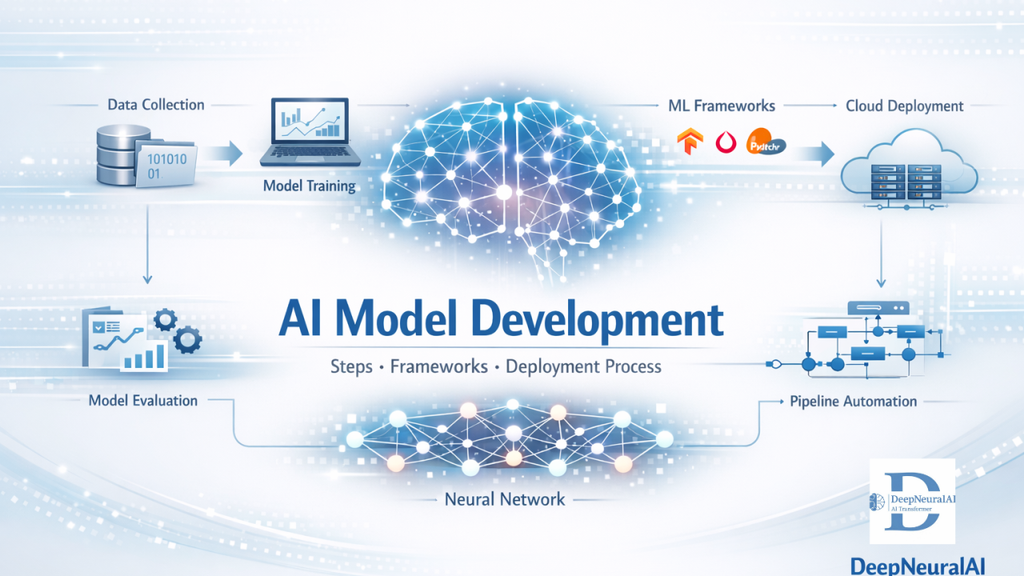
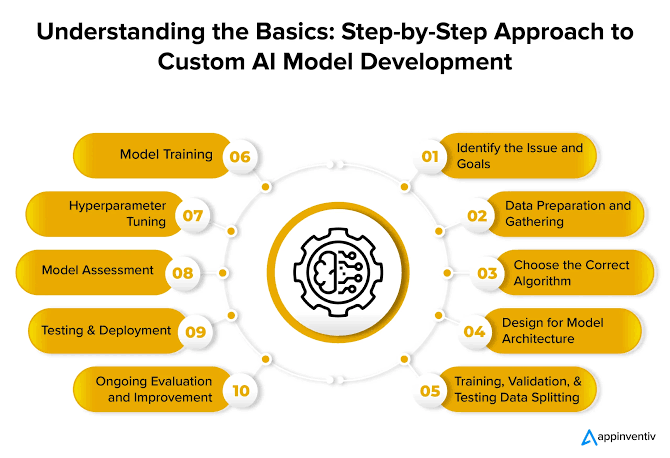
AI model development typically follows a structured lifecycle. The exact process depends on whether the project uses a traditional machine learning model, a large language model, or another AI architecture.
Step 1: Define the problem
Identify the business objective, intended users, success criteria, and constraints.
Step 2: Collect and prepare data
Gather suitable data, check its quality, address missing values, and manage privacy and permissions.
Step 3: Evaluate performance
Test the model on data not used for training. Measure relevant factors such as accuracy, reliability, fairness, and latency.
Popular AI Model Development Approaches
| Approach | Main purpose | Example |
| Machine learning | Learn patterns from data | Sales forecasting |
| Deep learning | Learn complex patterns using neural networks | Image recognition |
| Natural language processing | Understand or process human language | Text classification |
| Generative AI | Create new text, images, audio, or code | AI content assistant |
| Computer vision | Analyze visual information | Product defect detection |
| Reinforcement learning | Learn actions through rewards and feedback | Robotics and simulations |
Choosing the right approach is more important than selecting the most complicated model. For many business tasks, a smaller, well-tested model can be more practical than a large, expensive system.
Essential Tools for AI Model Development in 2026
Developers use different tools depending on their programming experience, infrastructure, budget, and application requirements.
- Python and machine learning libraries
Python, PyTorch, TensorFlow, and scikit-learn support data preparation, model training, experimentation, and evaluation.
- Cloud AI platforms
Managed cloud services can provide model training, deployment, data storage, and scalable computing without requiring an organization to manage every infrastructure component itself.
Benefits of AI Model Development
AI model development can provide several advantages when applied to the right problem.
- Greater efficiency: Automates suitable repetitive tasks.
- Data-driven decisions: Identifies patterns that support planning.
- Improved customer service: Powers assistants and intelligent search.
- Personalization: Tailors recommendations to relevant user needs.
- Innovation: Supports new products and services.
- Scalability: Allows organizations to expand successful applications.
- Competitive advantage: Helps businesses improve specific workflows and customer experiences.
The actual benefits depend on data quality, implementation costs, employee adoption, and the measurable value of the solution.
Challenges and Disadvantages of AI Model Development
Despite its potential, AI model development(https://ainewsbreak.co.uk/) introduces important technical and business challenges.
- Data quality problems: Incomplete, inaccurate, or unrepresentative data can produce unreliable results.
- High development costs: Specialized staff, computing resources, testing, and maintenance can be expensive.
- Privacy and security risks: Sensitive information must be handled with appropriate access controls and safeguards.
- Bias and fairness concerns: Models can reproduce harmful patterns present in their training data.
- Incorrect outputs: Generative AI systems can produce plausible but inaccurate information.
- Integration difficulties: Connecting models to existing systems may require significant engineering work.
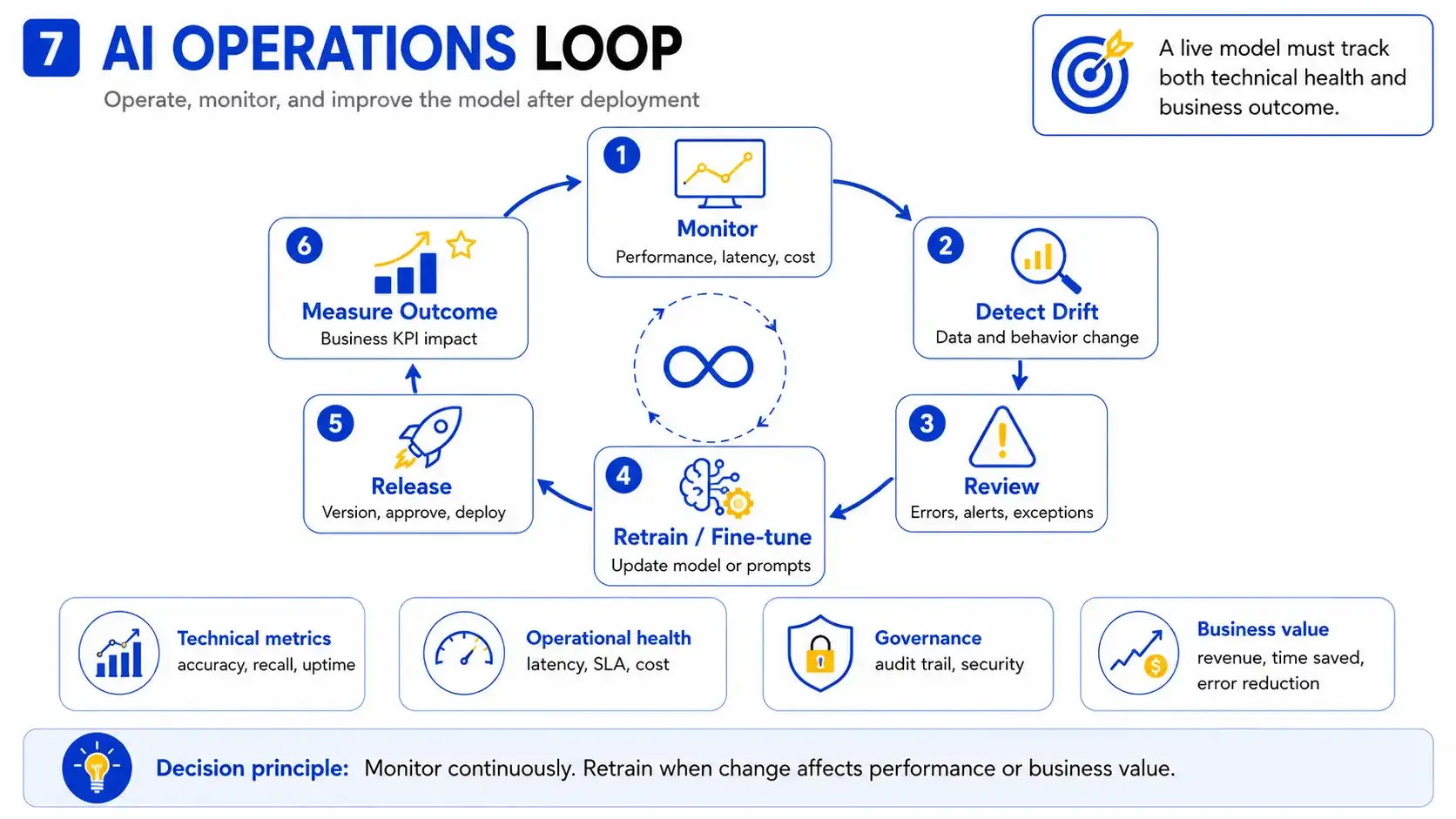
- Ongoing maintenance: Performance can deteriorate as data, user behavior, or operating conditions change.
Businesses can manage these challenges through risk assessment, representative testing, human oversight, security reviews, continuous monitoring, and clear accountability.
Best Practices for Successful AI Model Development
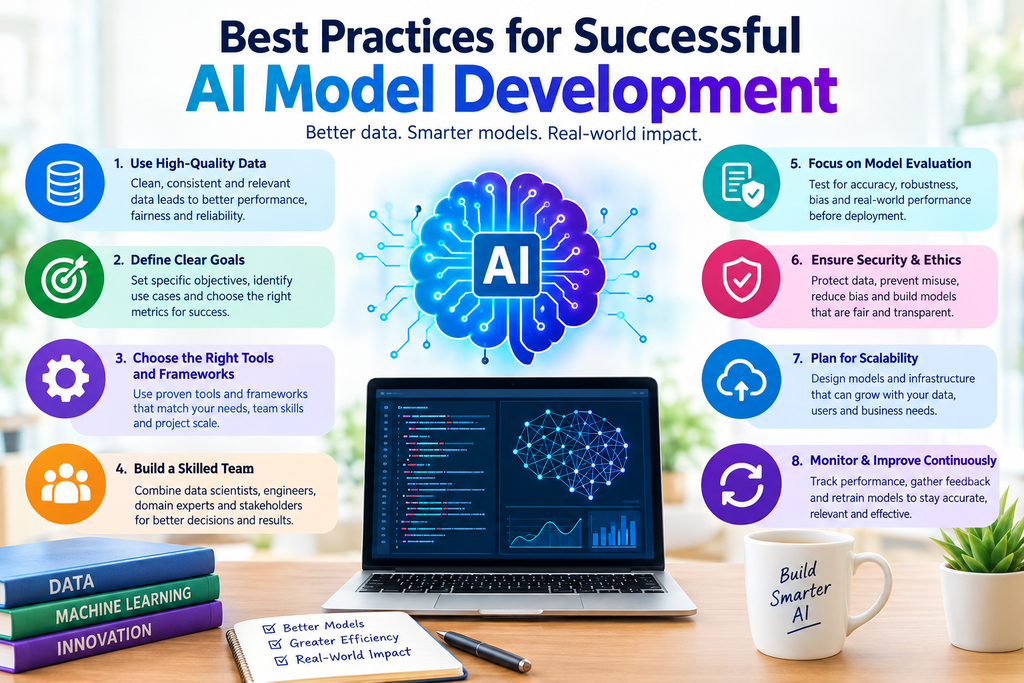
To build reliable AI systems in 2026, organizations should follow a practical and measurable strategy.
- Define a clear problem before selecting a model.
- Start with a small prototype and test its value.
- Use relevant, representative, and properly governed data.
- Compare multiple approaches, including simpler alternatives.
- Evaluate performance using metrics appropriate to the task.
- Protect user information and secure model access.
- Monitor performance, operating costs, and potential failures.
- Keep human review for high-impact or uncertain decisions.
- Document model limitations and establish update procedures.
Important: A successful AI project is not simply one that uses advanced technology. It is one that delivers measurable value while meeting appropriate standards for safety, reliability, privacy, and cost.
The Future of AI Model Development
The future of AI model development is likely to involve increasingly capable generative models, multimodal systems that process text and images together, smaller models optimized for specific tasks, and AI agents that can perform multi-step workflows under appropriate controls. Other important developments include improved inference efficiency, retrieval-augmented generation, specialized models for industry applications, and more systematic evaluation of AI reliability. Businesses may increasingly combine pretrained models with their own approved data instead of building every system from scratch. However, the best approach will depend on the use case, data sensitivity, performance requirements, and available resources. Responsible AI development will remain essential as organizations address transparency, security, copyright, fairness, and accountability.
Conclusion
AI model development is helping organizations transform data into practical intelligence. From smarter analytics and automation to personalized experiences and predictive maintenance, AI models can improve how businesses solve problems and develop new products. The seven approaches discussed in this guide demonstrate that successful AI development requires more than training a model. It also involves choosing the right technology, preparing quality data, evaluating performance, managing risks, and monitoring results after deployment.
In 2026, businesses that focus on practical applications, measurable outcomes, and responsible implementation will be better positioned to benefit from AI innovation.