A DevOps engineer: What is it?
An IT generalist with a broad understanding of both development and operations, including coding, infrastructure management, system administration, and DevOps toolchains, is a DevOps engineer. Since DevOps engineers work across organizational silos to foster a more collaborative environment, they also need interpersonal skills.
In addition to having a solid grasp of common system architecture, provisioning, and administration, DevOps engineers also need to be familiar with agile principles, source control, code reviews, unit testing, and other traditional developer tools and practices.
Functions and obligations
Although a DevOps engineer’s responsibilities will differ from company to company, they always involve a mix of release engineering, infrastructure provisioning and management, system administration, security, and DevOps advocacy.
The labor needed to develop and implement application code is included in release engineering. The precise tools and procedures differ greatly based on a number of factors, including the language used to write the code, the degree of pipeline automation, and whether the production infrastructure is located on-site or in the cloud. Release engineering may involve creating and managing custom build/deploy scripts or choosing, providing, and maintaining CI/CD tools.
Deploying and managing the servers, storage, and networking resources needed to host applications is part of infrastructure provisioning and system administration. Managing physical servers, storage devices, switches, and virtualization software in a data center may be part of this for companies with on-premise resources. This typically entails provisioning and managing virtual instances of the same components for a hybrid or fully cloud-based company.
DevOps advocacy is maybe the most crucial function of a DevOps engineer, but it is frequently underestimated or completely disregarded. The engineering team members may find the transition to a DevOps culture disruptive and perplexing. The DevOps engineer is responsible for promoting and educating the DevOps methodology throughout the company since they are the subject matter experts.
The Top 9 Skills of DevOps Engineers
A DevOps engineer’s technical requirements will change based on the technologies, toolkits, and team structure. However, effective teamwork and communication are crucial. A DevOps engineer should also be well-versed in every aspect of a delivery pipeline, as well as the advantages and disadvantages of various tools and services.
1. Cooperation and communication
Effective communication and teamwork with teams, management, and customers are critical for DevOps engineers. Although these so-called “soft skills” are sometimes disregarded and underappreciated, the quantity and quality of feedback received throughout the whole value stream is crucial to DevOps’ success.
2. Management of the system
System administration skills, including server provisioning and management, database deployment, security monitoring, system patching, and internal and external network connectivity management, will be familiar to a DevOps engineer.
3. Knowledge of DevOps tools
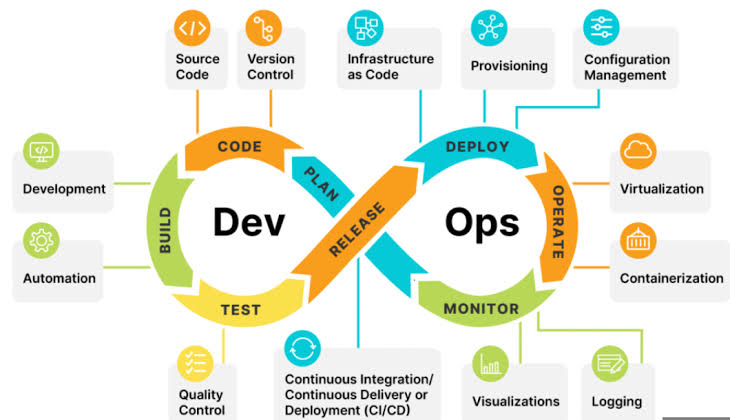
The DevOps engineer needs to be knowledgeable about and proficient with a range of tools since employing the proper tools is crucial to DevOps techniques. These technologies cover every stage of the DevOps lifecycle, from construction and infrastructure to product or service monitoring and operation.
4. Management of configurations

Experience with one or more configuration management tools, such as Chef, Puppet, or Ansible, is frequently required of DevOps engineers. To automate system administration chores like installing new systems or applying security fixes to existing systems, several organizations have embraced these or comparable solutions.
5. Container orchestration and containers
The application’s code and runtime environment are combined into a single image thanks to containerization, a concept made popular by Docker. This reduces the need for conventional configuration management solutions. However, maintaining containers presents its own set of difficulties, making familiarity with the family of tools known as “container orchestrators” (such as Docker Swarm or Kubernetes) essential for DevOps engineers.
6. Constant deployment and integration
The fundamental techniques of a DevOps approach to software development are continuous integration and continuous delivery (CI/CD), which are made possible by a variety of tools. Automating the software development, testing, and deployment processes is the primary purpose of any CI/CD solution or collection of tools.
In order to ensure that these tools are used efficiently, DevOps engineers typically need to collaborate closely with the rest of the development organization and have experience configuring and deploying one or more CI/CD tools.
7. Provisioning and system architecture
Whether on-premises or in the cloud, a DevOps engineer should be capable of designing, provisioning, and managing computer environments. Understanding Infrastructure as Code (IaC), an IT management technique that combines DevOps software development best practices to cloud infrastructure resource management, is crucial. A DevOps engineer should know how to use Terraform, AWS CloudFormation, or Amazon Web Services (AWS) to model system infrastructure in the cloud.
8. Knowledge of programming and coding
Writing shell scripts to automate tedious operations is a skill that many conventional system administrators possess. Beyond creating automation scripts, a DevOps engineer should comprehend sophisticated software development techniques and know how to apply agile development techniques like source control and code reviews.
9. Capabilities for cooperative management
Regardless of the particular organizational structure, cross-team collaboration is an essential part of a successful DevOps strategy. The DevOps engineer should collaborate and coach with a wide range of individuals throughout the company, regardless of whether the engineering team is split up only by roles or there are distinct teams for feature development, quality assurance, DevOps, etc.
For instance, the ability to provide engineers with feedback more quickly is one of the most beneficial returns on a DevOps investment. To increase the speed, effectiveness, and output of testing procedures, a DevOps engineer will frequently need to collaborate with QA (whether they be developers who build test automation or manual testers).
While working, developers could want assistance from DevOps engineers.
Other tasks and responsibilities of the DevOps team
DevOps evangelist
This DevOps specialist encourages and advances DevOps procedures throughout the company. Although the profession focuses on human communication and process improvement, the DevOps evangelist usually has a strong technical background.
Change advisory board/release manager
A distinct group known as the change advisory board (CAB) or an individual release manager position may be present in organizations that have not yet made the switch to DevOps or are in the early stages of doing so.
These positions are used to make sure that any new application software that is put into production satisfies security and quality requirements and has the necessary management approvals.
When software releases were riskier, these jobs were especially crucial. However, with the introduction of techniques like automated testing and dark deployments, these responsibilities become less significant, if not obsolete.
Automation specialist
Automation expertise is demanded of every DevOps engineer. However, having a distinct automation specialist or automation engineer position within a business is not unheard of. This person might be focused on creating and maintaining automated test suites or managing the CI/CD tooling.
developer of software
Those that write either front-end or back-end application code, or both, are typically referred to as software developers. Before the emergence of agile thinking, these individuals were referred to as “computer programmers.”
Assurance of quality
Finding software flaws is the responsibility of the quality assurance (QA) team. In the past, QA engineers have concentrated on manually evaluating new application code to make sure it doesn’t blow up right away (smoke testing), destroy existing functionality (regression testing), or conflict with any other new features (integration testing).
The software development engineer in test (SDET) position is increasingly being used by organizations to supplement or replace manual testers. Before new application code is put into production, the SDET concentrates on testing it. But instead of doing manual software testing, he or she concentrates on creating test automation code.
Engineer for security
An individual or team is frequently in charge of security in organizations that haven’t completely embraced the idea of incorporating security and compliance concerns into their planning and development processes. Because it makes security an afterthought and makes it far more difficult to protect software after it has been developed, produced, and deployed than it is to build with security in mind, this frequently turns out to be an antipattern.
Beyond a single position
DevOps calls for a shift in culture, the application of technological tools, and new management concepts. At the center of a DevOps transformation is a DevOps engineer, who needs to possess a wide range of abilities to support this shift. However, in order to apply DevOps and enhance the software development lifecycle, most firms would require a combination of generalists and experts rather than a single DevOps engineer. To fully achieve the potential of DevOps, a DevOps engineer assists in dismantling silos to promote cooperation across various specialists and across toolchains.