Introduction
As artificial intelligence becomes more capable, the way humans communicate with AI is becoming increasingly important. System prompting provides high-level instructions that guide how an AI model should behave, respond, prioritize information, and follow specific rules.
In 2026, system prompting is becoming an important part of building reliable AI assistants, business automation tools, customer-service agents, coding assistants, and AI-powered applications. Rather than simply asking an AI model a question, developers can establish a consistent framework that shapes the model’s behavior across many interactions.
What Is System Prompting?
System prompting is the practice of giving an AI model overarching instructions that define its role, behavior, objectives, limitations, and response style.
For example, instead of simply asking:
“Explain artificial intelligence.”
A system instruction might establish:
“You are an AI tutor. Explain technical concepts in simple language, provide practical examples, and avoid unnecessary jargon.”
The system-level instructions influence how the AI approaches subsequent user requests.
Simple Definition
System prompting is a method of directing an AI model’s overall behavior through high-level instructions and rules.
It is particularly useful when an AI application needs to behave consistently rather than responding differently to every individual request.
How System Prompting Works
A typical AI interaction can involve several layers of instructions:
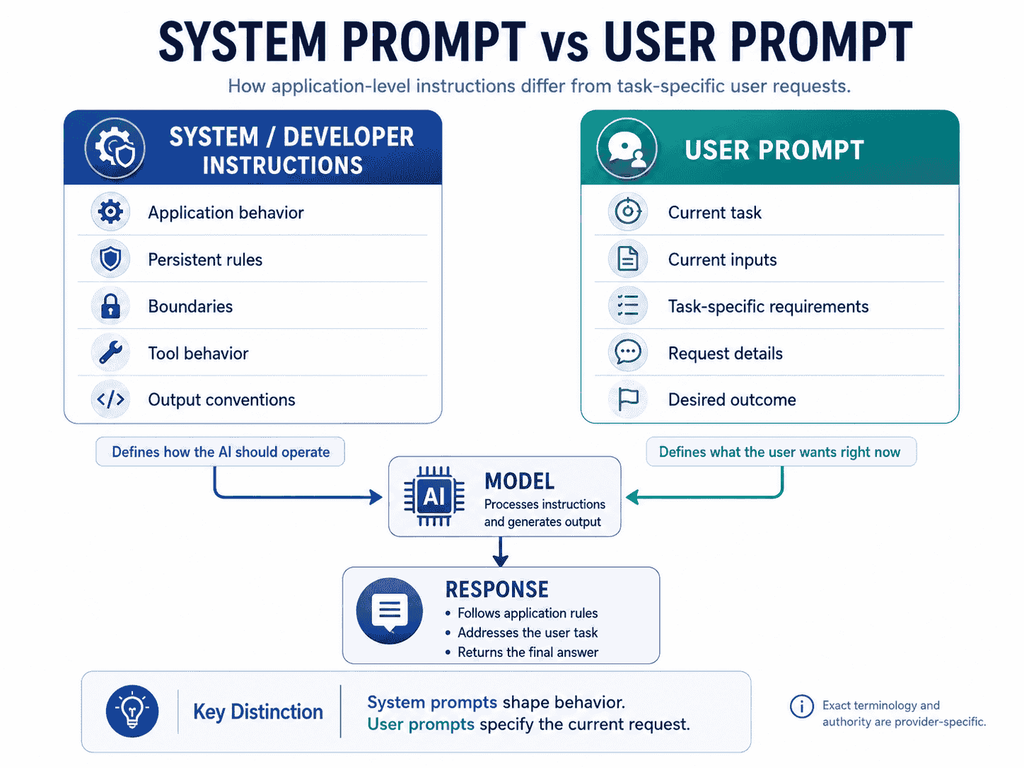
- System instructions – Establish overall behavior and rules.
- Developer instructions – Define application-specific requirements.
- User prompts – Specify what the user wants.
- Model response – Produces an answer based on the applicable instructions and context.
For example:
System:
“You are a professional financial education assistant. Provide educational explanations and clearly distinguish general information from personalized financial advice.”
User:
“What is compound interest?”
The system instructions establish the assistant’s role before it responds to the user’s question.
Why System Prompting Matters in 2026
AI models can generate impressive responses, but raw model capability does not automatically guarantee consistent or reliable behavior.
System prompting helps organizations establish predictable behavior across AI applications.
1. Better Consistency
A carefully designed system prompt can encourage an AI assistant to maintain the same tone, structure, and objectives across conversations.
2. Improved Response Quality
Clear instructions can help an AI understand what information is important and how the final response should be organized.
3. Stronger AI Personalization
Businesses can define whether an AI assistant should behave like a tutor, (https://ainewsbreak.co.uk/) customer-service representative, research assistant, coding helper, or another specialized role.
4. More Reliable AI Agents
AI agents often need to follow multiple objectives and constraints. System instructions can establish the agent’s operating framework before it performs tasks.
5. Better User Experiences
When an AI assistant consistently understands its role, users can receive more predictable and useful interactions.
Key Elements of a Strong System Prompt
A powerful system prompt usually contains several important components.
1. Role
Tell the AI what role it should perform.
Example:
“You are an experienced technical support specialist.”
2. Objective
Explain what the AI is trying to accomplish.
Example:
“Help users troubleshoot common software problems using clear, step-by-step instructions.”
3. Tone
Define how the AI should communicate.
Possible instructions include:
- Professional
- Friendly
- Concise
- Educational
- Formal
- Conversational
4. Rules
Specify important behavioral requirements.
For example:
“Do not invent information. If the available information is insufficient, clearly state what is unknown.”
5. Output Format
System prompting can specify how information should be presented.
For example:
- Use headings.
- Use numbered steps.
- Provide a short summary.
- Include examples.
- Return structured JSON when required.
6. Boundaries
The prompt can establish what the AI should avoid or how it should respond when a request falls outside its intended purpose.
System Prompting vs. User Prompting
Although both influence AI behavior, they serve different purposes.
| System Prompting | User Prompting |
| Establishes overall behavior | Requests a specific task |
| Defines role and rules | Provides the immediate question |
| Usually remains consistent | Changes from request to request |
| Controls application behavior | Expresses user intent |
| Useful for AI applications | Useful for individual interactions |
Example
System prompt:
“You are a professional writing assistant. Give clear, concise and grammatically correct responses.”
User prompt:
“Rewrite this paragraph in a professional tone.”
The system establishes the assistant’s general behavior, while the user provides the specific task.
System Prompting for AI Agents
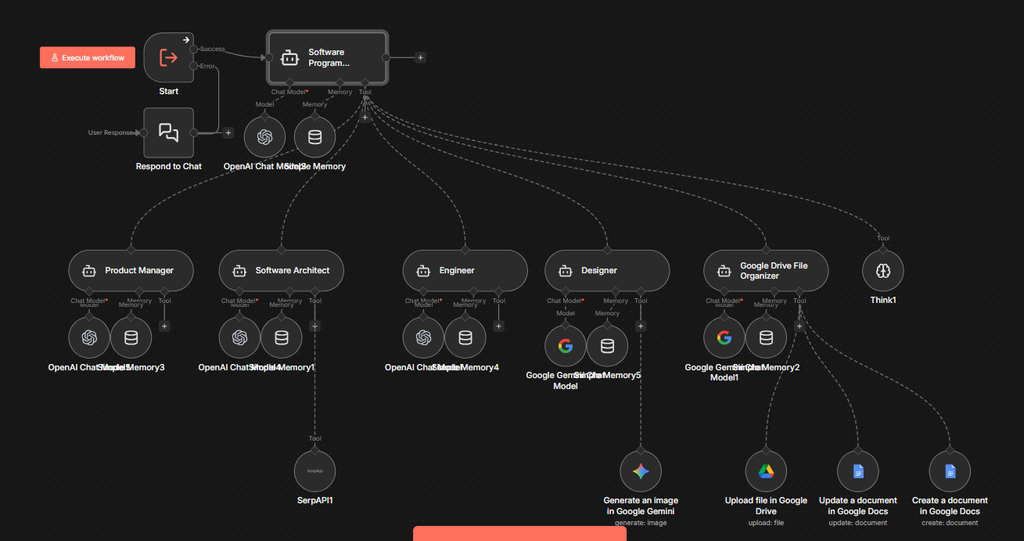
One of the most important applications in 2026 is AI agents.
AI agents can potentially:
- Analyze information
- Use software tools
- Retrieve data
- Complete multi-step tasks
- Interact with applications
- Make decisions within defined boundaries
System prompting can provide the agent with a framework for these activities.
For example:
“You are a research assistant. Identify reliable sources, distinguish facts from assumptions, summarize findings, and clearly indicate uncertainty.”
This gives the agent behavioral guidance rather than merely describing a single task.
System Prompting for Business
Businesses can use system prompting to create specialized AI assistants.
Customer Service
A customer-service AI could be instructed to:
- Be polite and professional.
- Answer questions using approved information.
Marketing
A marketing assistant could be instructed to:
- Maintain brand voice.
- Avoid unsupported claims.
Internal Knowledge
Companies can create AI assistants that help employees find and summarize organizational information while following specific policies.
System Prompting and AI Safety
Useful instructions may include:
- Do not fabricate sources.
- Clearly acknowledge uncertainty.
- Protect confidential information.
- Follow application-specific safety rules.
- Refuse inappropriate requests.
- Avoid presenting speculation as fact.
However, system prompting should not be treated as a complete security mechanism. An application should also use appropriate technical controls, authentication, authorization, validation, monitoring, and testing.
System Prompting Challenges
Despite its advantages, system prompting has limitations.
1. Ambiguous Instructions
Poorly written instructions can create inconsistent results.
Solution: Use precise language and clearly defined priorities.
2. Conflicting Instructions
Different instructions can sometimes conflict.
Solution: Establish clear priorities and define how conflicts should be handled.
3. Overly Long Prompts
Adding too many instructions can make prompts difficult to maintain and potentially consume valuable context.
Solution: Keep instructions relevant, structured, and concise.
Example of a Strong System Prompt
Here is a simplified example for an AI writing assistant:
You are a professional content-writing assistant.
Your goals are:
Produce clear, useful, accurate content.
Organize responses with descriptive headings.
Use a professional but accessible tone.
“Write good content.”
The first prompt defines role, objectives, behavior, quality requirements, and uncertainty handling.
Benefits of System Prompting
Consistent AI Behavior
AI applications can maintain a defined personality and operating approach.
Greater Control
Developers can specify important behavioral requirements.
Better Task Performance
Well-designed instructions can help models focus on relevant objectives.
Easier AI Specialization
One general-purpose model can be configured for different application roles.
Improved Scalability
A reusable system instruction can establish common behavior across many user interactions.
Stronger AI Workflows
System prompting can become one component of larger AI pipelines involving retrieval, tools, databases, evaluation, and automation.
Future of System Prompting
The future of system prompting is likely to move beyond simple blocks of text.
As AI applications become more sophisticated, system instructions may work alongside:
- Structured outputs
- Tool calling
- Retrieval-augmented generation
- Memory systems
- AI-agent frameworks
- Automated evaluations
This means the most effective AI systems will increasingly combine prompt design with software engineering and evaluation rather than treating prompting as a standalone solution.
Advantages of System Prompting
- Improves consistency
- Supports specialized AI assistants
- Helps establish behavioral boundaries
- Can improve response structure
- Supports AI-agent workflows
- Makes application behavior easier to define
- Helps organizations maintain a consistent AI experience
Disadvantages of System Prompting
- Poor instructions can produce poor results
- Prompts require testing and maintenance
- Instructions may conflict
- Prompt injection can create security challenges
- Different models may respond differently
- Prompting alone cannot guarantee safe or accurate AI behavior
Conclusion
System Prompting The Power Behind Smarter AI in 2026 reflects an important shift in AI development building effective AI is not only about choosing a powerful model, but also about defining how that model should operate.
A strong system prompt can establish an AI’s role, objectives, communication style, constraints, and response behavior. When combined with evaluation, security controls, reliable data, tool management, and thoughtful application design, system prompting can help create AI systems that are more consistent, useful, and dependable.
In 2026, system prompting is best understood not as a magic instruction that guarantees perfect answers, but as one important layer in the architecture of reliable AI systems.