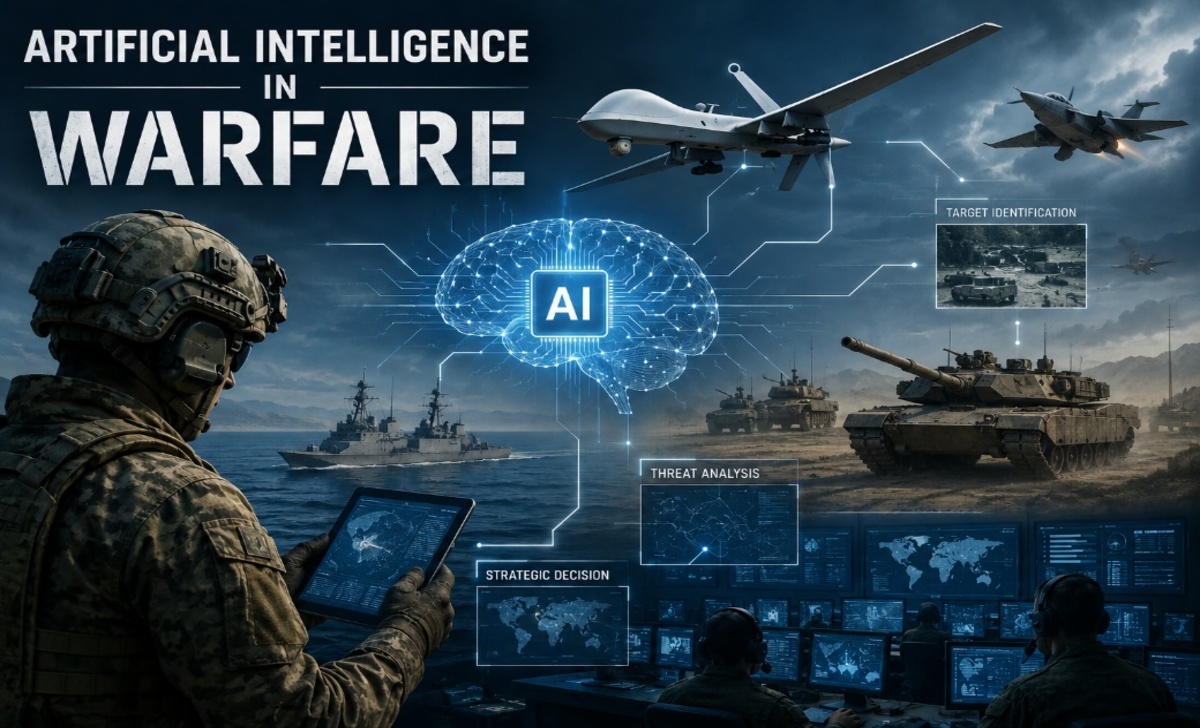
AI command in warfare refers to the use of artificial intelligence to support military command, decision-making, intelligence analysis, planning, and coordination. AI can process large amounts of battlefield data and help commanders understand situations faster, but human oversight remains important for consequential decisions.
1. What Is AI Command in Warfare?
AI command systems combine AI, machine learning, sensors, communications networks, and data analytics to assist military leaders. These systems can identify patterns, prioritize information, predict possible developments, and recommend courses of action.
The goal is generally to improve speed, situational awareness, coordination, and decision quality rather than simply automate command.
2. Major Applications
- Situational awareness: Combines information from satellites, radar, drones, sensors, and other sources.
- Intelligence analysis: Helps analyze large volumes of imagery, signals, and open-source information.
- Decision support: Generates possible options and highlights relevant risks or constraints.
- Logistics: Helps forecast supply requirements, transportation needs, and equipment maintenance.
- Cyber defense: Detects unusual network activity and helps prioritize potential threats.
- Command-and-control networks: Helps distribute information among units and maintain a common operational picture.
- Predictive analysis: Estimates potential developments based on historical and current data.
3. AI and the Military Decision Cycle
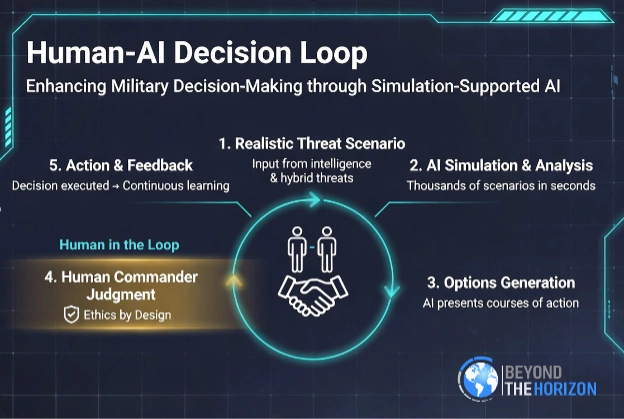
AI can potentially support several stages of the military decision process:
Collect data → Analyze → Identify patterns → Generate options → Human review → Decision → Monitor results
A key distinction is between AI-assisted command and fully autonomous decision-making. In AI-assisted command, people remain responsible for evaluating recommendations and making consequential decisions.
4. Benefits
Faster analysis: AI can process enormous datasets much faster than humans.
Improved situational awareness: Data from multiple sources can be combined into a more comprehensive picture.
Reduced information overload: AI can prioritize potentially important information for commanders.
Better logistics: Predictive systems can help identify maintenance and supply requirements before problems occur.
24/7 monitoring: Automated systems can continuously monitor large data streams.
5. Major Challenges
AI command also creates significant risks:
- Incorrect or incomplete data
- AI hallucinations and unreliable recommendations
- Adversarial manipulation of data
- Cyberattacks against AI systems
- Bias in training data
- Difficulty explaining complex AI recommendations
- Communication failures
- Overreliance on automation
- Escalation caused by rapid decision cycles
A particularly important problem is that an AI system can produce a confident recommendation even when its underlying information is wrong.
6. Human Control
One of the central debates around military AI concerns human control over the use of force. AI can potentially recommend actions or assist with targeting, but international humanitarian law requires decisions in armed conflict to comply with applicable legal obligations.
Responsible systems therefore emphasize concepts such as
- Human judgment
- Clear rules and authorization
- Testing and validation
- Auditability
- Fail-safe mechanisms
- Accountability
- Continuous monitoring
7. AI Command vs. Autonomous Weapons
These concepts should not be confused.
AI command: AI helps commanders analyze information and make decisions.
Autonomous weapons: A weapon system can perform functions with limited or no human intervention after activation.
An AI command platform does not automatically mean that weapons are autonomous.
8. Future of AI Command
Future military command systems are likely to become increasingly networked, predictive, and AI-assisted. Developments may include AI-generated operational summaries, automated intelligence fusion, improved logistics forecasting, and decision-support systems that help commanders evaluate rapidly changing situations.
However, the most important issue may not be how powerful the AI becomes, but how reliably humans can understand, supervise, and control it.
Conclusion
AI command in warfare is transforming military decision support by helping commanders process information, understand complex situations, coordinate forces, and make decisions more quickly. At the same time, unreliable data, cyber threats, automation bias, accountability, and legal concerns make human oversight essential. The future of military AI will likely focus on finding a balance between machine speed and human judgment.