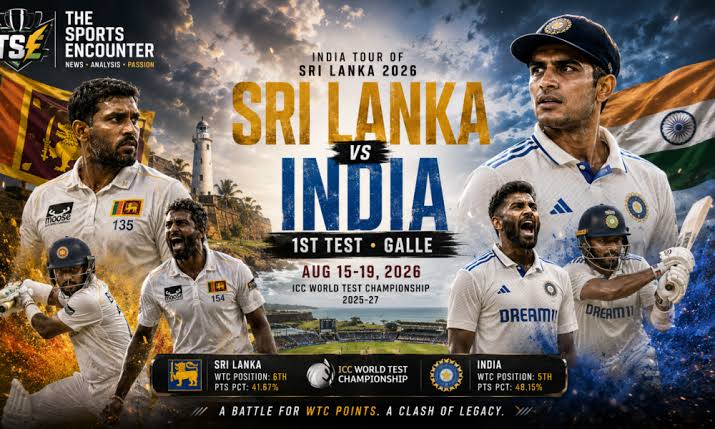
The India vs Sri Lanka 2026 Test series delivered a strong mix of Indian dominance, Sri Lankan resilience, and several performances that changed the outlook for both teams. India won the two-match series 1–0, while Sri Lanka saved the second Test in Colombo after being forced to follow on.
India vs Sri Lanka 2026: Series Overview
India entered the series with major pressure in the ICC World Test Championship 2025–27. The first Test in Galle ended with a convincing 165-run victory for India, giving the visitors a 1–0 lead. Left-arm spinner Manav Suthar was the standout performer, taking 10 wickets in only his second Test.
The second Test at Colombo appeared to be heading toward another Indian victory. India declared at 503/9, then dismissed Sri Lanka for 290, creating a 213-run first-innings advantage. India enforced the follow-on, but Sri Lanka produced an extraordinary recovery.
AI Match Battle: India’s Strengths
1. Spin Bowling
India’s biggest advantage was its spin attack. Manav Suthar, Ravindra Jadeja and Kuldeep Yadav created consistent pressure on Sri Lankan batters, particularly in Galle. Suthar’s 10-wicket performance demonstrated how effective India’s young spin option could be in Asian conditions.
AI takeaway:
India’s combination of left-arm spin, variation and sustained pressure gave it a significant advantage on turning pitches.
2. Strong Batting Depth
India also benefited from contributions throughout the batting order. Devdutt Padikkal was particularly impressive, scoring 167 in the first Test and later finishing the series as India’s leading run-scorer with 328 runs.
Dhruv Jurel also produced an important century in Colombo as India built its massive first-innings total.
AI takeaway:
The data suggests India’s depth was one of the biggest differences between the teams. India could receive substantial contributions from both established players and emerging talent.
Sri Lanka’s Biggest Advantage
Sri Lanka’s greatest strength was its resilience under pressure.
After being forced to follow on in Colombo, Sri Lanka appeared almost certain to lose. Instead, Sonal Dinusha produced a remarkable unbeaten century in the second innings. He had already scored a century in the first innings, making his performance one of the defining stories of the series.
AI takeaway:
Sri Lanka demonstrated that aggressive bowling alone was not enough for India to secure victory. Long defensive partnerships and disciplined batting dramatically changed the match trajectory.
Key Player: Manav Sudhir

Manav Suthar emerged as one of the biggest winners from the series.
His 10-wicket haul in Galle immediately established him as a serious Test prospect. His ability to maintain pressure and extract variation from the surface gave India another valuable spin option.
From an AI-performance perspective, his importance comes from three areas:
- Consistent line and length
- Ability to bowl long spells
- Effective variation on turning surfaces
Key Player: Sonale Dinesh
If Suthar represented India’s breakthrough, Sonal Dinusha represented Sri Lanka’s resistance. His unbeaten 133 in the second innings at Colombo helped Sri Lanka escape from an extremely difficult position. His performance also highlighted an important lesson: cricket analytics can identify probability, but a determined individual performance can completely disrupt a projected match outcome.
Shubman Gill’s Leadership
India captain Shubman Gill had plenty to celebrate after securing a 1–0 series win, but the Colombo draw also represented a missed opportunity. India dominated large portions of the second Test and had Sri Lanka under enormous pressure. However, Sri Lanka’s late resistance prevented India from completing a clean sweep. Gill later emphasized the positives of India’s performance in difficult overseas conditions.
AI Prediction vs Reality
Before the final stages of the Colombo Test, India’s position made a victory look highly probable. India had a huge first-innings lead and had enforced the follow-on. But the final result demonstrates why AI cricket prediction should be viewed as probability rather than certainty.
| Factor | India | Sri Lanka |
| Series result | Won 1–0 | Lost 0–1 |
| First Test | Won by 165 runs | Lost |
| Second Test | Dominated early | Saved a draw |
| Spin strength | Excellent | Less consistent |
| Batting resilience | Strong | Excellent late resistance |
World Test Championship Impact
The 1–0 series victory helped India, but the drawn Colombo Test prevented a potentially valuable additional win. India remained fifth in the WTC standings with a 51.52% points percentage after the series. India therefore still faces a difficult route toward the WTC final. The result shows that winning away from home is important, but converting dominant positions into victories is equally crucial.
What AI Analysis Reveals

The India vs Sri Lanka 2026 series provides several useful analytical lessons:
India’s advantage: superior spin depth, batting depth and sustained pressure.
Sri Lanka’s advantage: resilience, defensive batting and the ability to exploit India’s inability to finish the Colombo Test.
Major breakthrough: Manav Suthar’s emergence as a promising Indian spinner.
Major surprise: Sri Lanka’s ability to save the second Test after following on.
Series-defining performer: Sonal Dinusha’s twin centuries in Colombo.
Final Verdict
India vs Sri Lanka 2026 was ultimately India’s series, but not a complete domination. India won the series 1–0, convincingly taking the first Test by 165 runs. However, Sri Lanka’s extraordinary recovery in Colombo prevented a 2–0 sweep.
From an AI match analysis perspective, India’s spin attack and batting depth made it the stronger overall team, while Sri Lanka’s fightback demonstrated why live match conditions, player momentum and resilience can overturn even a highly favorable statistical situation.
SEO conclusion: India vs Sri Lanka 2026: AI Match Analysis shows India’s dominance, Sri Lanka’s resilience, and the emerging impact of young stars such as Manav Suthar and Sonal Dinusha.